Monday, 25 March 2019

News of grandchild no 5


Me siento un poco deprimido esta maƱana. Tom, Lucy, Julia and Aureliano are on their way back to Ecuador after spending a couple of weeks with us.
I am writing this in bed at 7am in the morning and there’s no little moley under my duvet. The gang should be an hour or so from Mexico City, where they have a 10-hour stop-over before flying on to Quito. They will reach Quito around midnight GMT which should be 6pm in Ecuador.


Two weeks goes so fast, it seems only a day or so since I was picking them up from Heathrow. Margaret’s big worry was that they would have forgotten us, but Julia recognised me straight away and Aureliano, who was only one year old when he left, was also clearly excited.
Julia had been worried that we might have died, that Holly might have died, and that Margaret might have thrown away her things. Over the next couple of days, it was lovely to see her relax back into her English routine and to rediscover all her toys and possessions.
Julia has grown up a lot. Her language has come on (especially her Spanish), and she’s bigger and more independent. She left us in the midst of the terrible twos and she returned as a ‘threenager’, so there was the odd tantrum, especially towards the end of the holiday when I think she picked up on the general mood of depression (from us that they were going back and from Tom and Lucy the stress of a day-and-a-half cooped up in a plane).
Aureliano is more daring than Julia (he’d love to be able to jump) and he soon settled down into a routine. He’s only grumpy if he’s hungry, so if he starts to cry, give him some food. Aureliano speaks Spanish, but understands English even if he has few words. His vocabulary is mainly:
Teta – he wants breast milk
Nom-nom – he wants food
Chao – goodbye (accompanied by a wave)
Por favour – said in an especially pathetic voice when he wants breast milk and Lucy isn’t inclined.
Hello – which is pronounced the Spanish way, without an H and with a ‘yuh’ sound for the double L (eh-yo). This is also accompanied by a wave and is so incredibly cute.

His name for Julia is "oo-a".
He can also whistle (amazingly) and loves to sing and dance.
The big news that Tom and Lucy brought back was that they are going to have another baby. We will have a fifth grandchild. The baby (my bet is another boy) will be born in October and the plan is to return to the UK in September, about a month before the due date.
They will live with us for a while and then, depending upon visa requirements, they will either go back to Ecuador until September 2020 or get their own place in the UK. They want the child to be born in the UK, so he or she has a British passport (like the others). It’s relatively easy to get an Ecuadorian passport and citizenship, not so this inhospitable country.
So we have something to look forward to in the autumn, but back to this month …
Sadly, Aureliano picked up some kind of bug within a day of arriving. On Saturday, he was playing nicely in the garden when there were a couple of incidents. He was a bit slow going down the slide, so Julia gave him a shove and he crashed a little at the bottom; then he tripped on the uneven path and fell over. I think he was getting tired, but had I known him better, I would have realised something wasn’t quite right.
In the afternoon, we went to Springfields at Spalding, which is an out-of-town shopping area with playground. It was a bit of a cold, blowy day and both Aureliano and Julia were very grumpy when we tried to buy them shoes (normally it’s a real pleasure for Julia). We then went to the play area, which was OK, but Aureliano wasn’t really happy, despite doing his best to enjoy it.
Sad-looking Aureliano doing his best to enjoy the ride-on tractors
at Springfields in Spalding.
That evening, he vomited and went off his food and it took him three or four days to get over it. He’s a stoical little fellow, but we were all worried. Once he had recovered, he never stopped eating – he loves a boiled egg (or two) for breakfast and he loves fruit (grapes and kiwis were a big hit). Also, you can’t go far wrong with pasta and pesto.
Lucy is potty training him and he’s got it pretty well sewn up, although he does like to make the “poo face”, so there were a few false alarms.
We didn’t have anything planned for the holiday, so it was a bit of a muddle. Should we go to London? Should we try Center Parcs? In the end, we found a barn conversion for three days near Reepham in Norfolk and Max and Inna were able to join us.
The barn was rather nice, very spacious with underfloor heating, so it felt very comfortable and it was really well fitted out.
On Thursday, Tom, Lucy and Inna went to Norwich with Aureliano; Max stayed in to look after the dogs and Margaret and I took Julia to Roarr! – Norfolk’s very own dinosaur experience. Arthur loves Tamba Park on Jersey and I expected this to be a big hit.
It was a big hit in the wallet. They charged us £45 to get in, but we’d driven up to the place and I didn’t want Julia to think grandad was a skinflint, so I coughed up. On the way up the drive, there were strategically placed dinosaur models. I pointed them out to Julia and she said: “They’re only bones.”
I thought she was going to be singularly unimpressed, but once we’d paid and went through the door, there was a seven-foot dinosaur that moved its head and roared as we went past. Julia was terrified! Not a bit scared, she was absolutely terrified. We had to carry her past a couple of other models (silent ones thankfully) and took refuge in the indoor play area. This would have been a huge success had she not seen the velociraptor near the soft-play slide. She managed a snack and drink and a very quick play in the ball pit where the dinosaur couldn’t be seen.

We ventured out and she was interested in the mammoths, the Neanderthals and sabre-toothed tigers; she also enjoyed the mini zoo and the farm animals, but we had to leg it past the T-Rex on the way back. So Roarr! Wasn’t a roaring success. Lucy said later that Julia had been frightened of dinosaurs and she’d told them they were all dead so there was nothing to worry about – there were only bones left. I think she was happy with that explanation until the bones moved and roared.
It was windy and showery, not great weather for the beach, but Max and I took the dogs to Sheringham in the afternoon. I was hoping the tide would have been far enough out to expose the sandy beach, but it wasn’t, so we walked part-way to Weybourne on shingle. It’s hard going and the whippets were not too impressed.
On the beach at Sheringham - hard going on the shingle.

The barn came with Netflix and, that night, we watched Roma, a film that’s won loads of awards. It was very good – made me cry (which isn’t hard).
Chilling on the sofa.
It was still windy and showery on Friday. We all went to Hunstanton for a walk on the beach. Aureliano was excited to see the sea, but it was too cold and windy for the children, so they headed for Hunstanton town and we walked on the beach with the dogs. The whippets were much happier on sand than shingle and really got some speed up trying to catch redshank. They even had a short swim/paddle when they found themselves on the opposite side of a creek to us. Normally, they don’t like water (even paddling in puddles) but Ollie did once jump into the river at Toneham when he saw Holly swim across to the other side. I think he expected to be able to walk across and it was quite a shock when he couldn’t. He got out fine, but it took a while for the adrenalin to wear off. This time Archie managed to wade/plunge across the creek, but Ollie chose a deeper section and needed a few strokes. There was a slight panic in his stroke – they’re not water dogs. Tom took this video of us collecting shells on Hunstanton beach - click HERE
We all met up again and had lunch in a pub on the way back. They were very accommodating of dogs and children, so that was nice. The food was pretty good too and because I wasn’t driving, I allowed myself a couple of pints of Woodforde’s Wherry.
In the evening there were a couple of rounds of Catan, a board game. Lucy won both games (no surprises there – she’s as ruthless as ever).
It was a really nice break and a good place to stay. I found Reepham a bit pretentious (too many antique shops and fancy food stores) and it’s a nightmare to walk around because the main road through is fairly busy and the pavement disappears whenever the road narrows. It does have an interesting church (or churches). Two are built, end to end, so that it looks like one church with two towers. Why didn’t they build one big one? Who knows – God’s house has many rooms!
We had a nice drive back along the B-roads to King’s Lynn, Max headed back early because Inna had a baby shower and Tom & Co headed to Sheringham for a look around.
I had enjoyed reading Room on the Broom and Stick Man with Arthur and so I bought the books for Julia. She’s always loved books and it was interesting reading stick man to her; I could see that she was really worried that he might not get back to his family. She’s developed a level of understanding and empathy that wasn’t there previously.
Julia and her friend at music club
The weather picked up thankfully and the second week was much warmer and less windy. It meant the children could play outside, but the time flew by. Faz came up to see Tom, Lucy had to go to Cambridge for a day, Tom and Lucy spent a day in London and a day in Baldock, there was some last-minute shopping for Marmite, Yorkshire Tea and Ginger Nuts (essential supplies for Brits abroad).
It was nice to go back to Crowland soft play and to Thorney Park – two old favourites – and Margaret loved taking them back to Matthew Coates music sessions and to Play and Chat. Julia met a little girl at music that she’d not seen for a year. Margaret said they knew each other straight away and gave each other a huge hug.
We were amused by how much Aureliano loved the purple buggy. He wakes up around 6am, starving hungry, but needs a sleep at lunchtime. We found the buggy a perfect way to get him off to sleep. He loved being tucked in and wheeled around, there would be some contented singing for a while, then ZZZs.
I ran them all back to Heathrow on Friday for a 10.30pm flight home via Mexico City, where they had a 10-hour stop-over before heading on to Quito. It was the cheapest option and seems to have worked reasonably well. I hope the Ginger Nuts weren’t too crushed when they unpacked.
Aureliano will always have a snooze in the buggy

Catan at the Barn - Lucy won 2-0.


Friday, 8 March 2019

Books Read in 2019


The Wild Places by Robert Macfarlane
This was a 65th birthday present from Max and I found it quite a hard book to read (which is why it took me almost six months). I kept reading it and putting it down for a month until I finally finished it in early January.
Macfarlane poses the question: are there any truly wild places left in the British Isles? I guess that depends upon your definition of “wild”. There are some wild places in Thorney – my allotment until I took it over and the patch of land next door hasn’t been disturbed for 15 years.
So my definition of wild is probably much less rigorous than Macfarlane’s. He sets off to visit a list of places he has identified as fitting his definition and they include remote islands, coastal strips, bogs and mountains. The usual suspects are there – Rannoch Moor gets a chapter – and I found his writing in the first part of the book a little unconvincing. There didn’t seem to be a connection, he didn’t seem comfortable or happy in the places he wanted to experience.
He did seem to visit them during periods of extreme weather and there was a piece about spending the night on the summit of Ben Hope in the middle of winter, which sounded quite reckless (unless he was exaggerating his predicament). In the latter part of the book, he seemed more at ease with the “wild” environment he was visiting, but it was a lot less wild Norfolk, Suffolk and Essex coasts, lost holloways in the south-west … These were the more interesting bits, but then he’s off again trying to find an arctic hare in Derbyshire in the middle of a November storm.
I’m going to pass the book on to Sam who has been watching and enjoying the YouTube channel of a chap in North America who goes wild camping in the woods.
The Spanish Civil War by Antony Beevor
I knew very little about the Spanish Civil War, except that when I was little Franco was still something of a bogeyman. Spain (and Portugal too) was a place you didn’t want to visit – run by a fascist dictator, backward, dominated by the Catholic Church (and don’t forget what they did in 1588). My knowledge of Spain was limited to what we read in the Daily Herald – they killed bulls for fun, they threw donkeys off church towers, you could be arrested for wearing a bikini.
Later, I read Ernest Hemmingway’s For Whom the Bell Tolls and then Laurie Lee’s As I Walked Out One Midsummer Morning and A Moment of War. Later still, I read a little about the Anarchist movement in Catalonia and I have been referring to events in the civil war during my Spanish lessons. Poets, composers and artists we may look at during lessons (such as Manuel de Falla) were greatly affected by the war. Falla, the greatest Spanish composer of the 20th century, lived in exile after the war and refused to return to Spain despite being offered a generous pension by Franco. The Gipsy Kings were descendants of Basque gipsies, who were forced to flee to France after the Republicans lost the war.
Beevor’s writing is pretty much a factual, chronological narrative, and is easy to read; although the complicated pre-war politics and multitude of unfamiliar names do make you pause quite often and say: “who the heck is he and what side was he on?”
The background to the war is one of immense poverty in Spain, with industry (generally) and land (absolutely) in the ownership of a small, wealthy class. There was dissatisfaction with the monarchy, including a dispute over rightful succession, and dissatisfaction among the poorer classes with the Catholic church. A strong left wing movement - including socialists, communists and anarchists – had arisen (especially in the Basque and Catalan industrial areas) and to complicate things further, there was a desire for Catalan independence, while the Basque country largely was a semi-independent entity.
The Spanish ‘left’ was an unhappy coalition. The communists (some way from Stalinism) were the smaller party and not happy bedfellows with the socialists, while the anarchists, by definition, were not going to fit in anywhere. They wanted collectivism, no government, no money, no army … The fear of anarchy (it’s still a loaded word) led to a campaign of fake news against the movement across Europe. Catalonia in Spain was its strongest place and when allowed to, during the civil war, anarchists did run factories and farming in a pragmatic, efficient way. John Lewis and the RNLI, both held up as shining examples by many, are (you could argue) anarchist organisations.
The war started when the left won democratic elections in 1936. Leaders of the armed forces led a coup, which was only partly successful. The navy remained largely loyal and parts of the army also remained loyal. Franco emerged as the leader of the Nationalists and, helped by German and Italian military support, he finally won a bloody war that lasted three years.
Russia supported the Republicans, but did them no favours. Stalin basically took all the country’s gold reserves and gave them a few (no enough) weapons, but lots of communist advisors. His aim was to make the relatively small Spanish communist party the leader in government.
The role of Briatin, France and the USA was shameful. The British maintained neutrality, while providing Franco with considerable support; France wished to be more helpful but deferred to British policy for fear of upsetting its ally and the USA, led by a strong Catholic pressure group (including the Kennedy dynasty) also thwarted democratic government.
Had we supported the Republicans, some argue Hitler may have thought twice about launching the Second World War. At least, we would have had an ally against Fascism had WW2 still started.
The most shocking thing about the Spanish Civil War was its brutality. Franco said he’d reunite Spain even if he had to shoot half the Spaniards (and that’s pretty much what happened). His Moroccan mercenaries were ruthless murderers, rapists and pillagers of conquered territory, while Hitler and Mussolini used the war as a testing ground for weapons and tactics that would be employed during WW2 against France and Britain.
The bombing of Guernica is well documented, but Madrid and Barcelona (and many other cities) were carpet-bombed against the Geneva convention, civilian refugees were machine gunned by aeroplanes and weapons such a napalm were developed by the Germans. The causes of Basque and Catalan separatism were ruthlessly supressed, Castellano imposed across Spain and church attendance made more or less compulsory.
It’s extraordinary that all this happen only 80 years ago – one lifetime. What a mess Europe was in so recently and what a blessing that Spain, Portugal, Italy and Germany are now democratic governments working together within the EU. |What a shame that some elements, especially within the UK, now seek to pull out of this movement for peace, co-operation and unity.

Wednesday, 6 March 2019

A week in sunny Tenerife


Just back from a week in Tenerife with Sam, Lucy, Arthur and Saoirse. We stayed at the GF Victoria in Adeje and it was great weather – up in the high 20s and lots of sun.
We went to Adeje around this time last year and stayed at the Roca Nivaria. This year’s hotel, another five-star inclusive package, was better for Arthur as the swimming pools were more child-friendly and there were lots of them.
It’s great to have a sunny, warm week in winter. While we were away last year, we had a really chilly February with a bitter storm dubbed ‘The Beast from the East’ but February 2019 has been unseasonably warm with record temperatures recorded and lots of sun. There were bumble bees and butterflies in our garden in mid Feb and all the spring bulbs are well advanced.
I could have got a sun tan working at the allotment, but you never know these things when you book.
Holidays are quite expensive and here’s (roughly) what this one cost.
Hotel - £2,500
Drinks and extras - £350
Flights - £350
Hotel at Gatwick - £100
Parking - £50
Dog boarding kennels - £120
Taxi transfers - £50
It’s around £3,500, so not one of those holidays where it’s cheaper to live in Spain than it is in the UK. We also had Jason Robinson in to paint the stairs while we were away, so that was an extra £470 – my poor old bank balance!
In the Sky Bar before the grandchildren arrived.
The Victoria is really nice. The room was great – we were on the fifth floor – and there are glass lifts at various points. We had a balcony with views of the family and adults’ pools, also an Atlantic sunset, there was a lounge, separate bedroom, en-suite bathroom and additional shower/loo. Two TVs, tea and coffee, fridge, safe and lots of wardrobe space.
The hotel is modern and quite stylish, with two bars, two restaurants and lots of sports/play facilities.
We were supposed to arrive all together on the Saturday, but Sam’s holiday package went wrong when the airline taking them to Tenerife from Jersey went bust. There have been several small airlines bankrupted as we head towards Brexit. It’s probably not all Brexit’s fault, but it is a major contributing factor.
It meant that instead of getting there on Saturday, his holiday was now Monday to Monday and so we missed two days with the grandchildren.
We spent Saturday looking around the hotel (that took a while) and popping into the nearby shopping centre to buy a hat. I’d left my Panama at home (you always forget something). There’s a nice open-air bar on Planta Cinco where it says you can watch the sunset over the Atlantic. You can, but another pretty hotel with a little bell tower blocks the view of the orb disappearing into the water.
The hotel was very quiet – there were only four people in the bar and definitely no need to worry about finding a vacant sun-lounger. Breakfast and dinner were in the price (not lunch and not wine). We took meals in the restaurant on the ground floor, which was a help-yourself feast (if you wanted it to be). I had fillet steak three nights (cooked to order), pork steak another night and once I went Italian and had risotto followed by pizza. There was a choice of sweets (a little on the sickly side) and a good selection of cheese. Breakfasts (for me) were porridge or rice pudding, followed by fruit, nuts and yoghurt. I had scrambled eggs and toast on a couple of days.
There was entertainment in the ground-floor bar each night from 6am to 9pm. We saw a decent singer and a violinist; a mediocre rock band playing covers and a useless pianist. We quite enjoyed the acrobat troupe.
Chatting to artists and people in the bar, it’s amazing what a small word we have become. A singer was from the Czech Republic and she spoke English, Spanish and Russian (at least), the violinist was Hungarian and he’d lived in Ireland and Spain (where he’d met his Argentinian wife) before moving to the Canaries; waiting staff were from Morocco and Venezuela (among others) and guests were from UK, Austria, Russia and Scandinavia (among others). It’s such a shame that the EU’s freedom of movement, which can allow a Czech singer to work in the Canaries, is being lost. As the world gets smaller and more open, Little England is pulling up the drawbridge and saying “we don’t want to be part of this.”
Arthur had enjoyed the open-air play pool on the Fifth Floor. It was paddling-pool shallow and had lots of fun slides for toddlers. He’d been on all the toddler slides on Tuesday and also in the big family pool on the Second Floor level in the afternoon.
It was really encouraging because he was quite nervous about water last year. I bought him a bucket and water squirter and Sam got him some Paw Patrol arm-bands, so we thought he’d be well set for the week. However, on Wednesday, he didn’t want to go in the water and wasn’t interested in the slides. He was coaxed in, but wouldn’t do more than paddle or play with his bucket and squirter. Saoirse was taken for a dip and tolerated the wet, but was not really up for it. She seemed quite shocked and puzzled by the experience.
On Friday, Sam and I (in an effort to encourage Arthur) went on the two big water slides in the deep part of the fun pool. One was rather nice, but the other was a high, closed tube that turned you over like a bobsleigh and gave my sinuses a jet-wash when I plunged into the water. Arthur wasn’t inspired by our heroics.
Our trip home was good. We left the hotel at 9.30am, Tenerife South airport was busy, but our flight was on time and we landed at Gatwick around 4.45pm. We got through passport, baggage and customs pretty quickly and were lucky to find a car-park bus waiting at the stop.
Head-to-head with grandma.
The roads were really quiet and we were at Friar Tuck’s in Whittlesey at 7.50pm for two Senior Meal Deals.
Jason has done a nice job on the stairs and Holly was delighted to see me on Sunday morning. I think a spell in kennels does her good, it makes her appreciate what a cushy life she has!
After-dinner cocktails (and rum)


Jason has done a nice job on the stairs.


Thursday, 21 February 2019

Visit to St Andrew's Church, Thornhaugh


Margaret and I visited St Andrew’s Church, Thornhaugh last week with the Peterborough U3A Churches and Teas group.
Thornhaugh is one of those places that I’ve driven past many times (mainly on the slip road heading north on the A1) but which I’ve never actually visited. At one time, I guess, the A1 Great North Road would have passed closer to the village or even through it and I suppose that the current village main street may have been the main east/west road.
It seems that for many years, Thornhaugh was the bigger village between itself and Wansford, but now it’s very much an undeveloped backwater.
The church is pretty and well-kept and has a huge rectory next door (now a private house and on the market when we visited).
The church has a tower with a ring of five bells (a number of which were cast in Stamford). The tower once had a spire which collapsed, taking out the entrance porch and the south aisle. The church was rebuilt without a spire and also without a south aisle.
View of the altar through the squint-hole.
The church has very little stained glass, which, on a sunny spring day, gave it a wonderful sense of light and lovely views through the windows. There are some interesting features, including a squint hole from the southern transept.
This gives someone sitting in the transept a clear view of the altar and the vicar told us that the squint hole allowed people a view of the communion ceremony. It was believed (and still is in the Catholic Church) that the communion ceremony turns the communion wafer from biscuit to the actual flesh of Christ. This magical process is known as transubstantiation. The vicar said people wanted to see this change in action and thus these squint holes were created.
It’s an interesting idea and I like the thought of people wanting to witness this mediaeval conjuring trick.
However, there are other possible explanations. Another idea is that these spy holes were to allow lepers (who were segregated due to the virulence of their disease) to view the communion service and it’s also suggested that the holes may have served the same purpose for extreme Christian hermits, who did not want any contact with other people.
The squint hole at Thornhaugh does give a very good view of the altar, so it hardly requires a squint and because it’s sited in the south transept, it’s hard to see how lepers or hermits may have benefited, unless they were able to enter the church building.
Tomb of William Russell, Baron Thornhaugh.
The other interesting feature in the Church is the tomb of William Russell, Baron Thornhaugh, who died in 1613.
Russell owned land in the area and lived at Thornhaugh Manor (just up the road and now a large farmhouse). He was the third son of the Second Earl of Bedford (Francis Russell) and he began a number of projects to begin draining the Cambridgeshire Fens. His son (also Francis) became the fourth Earl of Bedford and continued the drainage work.
It’s thanks to them that we now have such rich and productive farmland where I live now (on the Bedford Level) and it was their ancestors, in the 19th Century, who built the model village of Thorney for their estate workers.
There’s a Russell Close in Thorney and also a Tavistock Drive and Woburn Drive – all names with connections to the Russell family and dukes of Bedford.
Thornhaugh also has memorial tablets to John Wing, a former rector and there’s a memorial tablet to him in Thorney Church as well. As well as sharing benefactors, it seems Thorney and Thornhaugh also shared rectors.
In the churchyard, there's a tall cedar of Lebanon (recently heavily pruned) and we collected some interesting cones and cups from around the floor. 

Cedar of Lebanon (top) and the interesting cones and cups
we were able to gather.


Wednesday, 30 January 2019

Saoirse gives me a workout


I am just back from four days in Jersey to see my new grand-daughter Saoirse, Sam, Lucy and Arthur (who will be three in a few weeks).
I always find new babies a bit scary. They feel so small and light, as if they might break if you’re not really careful.
Saoirse is quite big for a six-week-old baby. She’s very long and very strong. She is moving her head around and looking at things. Her eyes are very knowing, you’d swear that she understands everything that’s going on.
She is feeding well and is a very good baby. She sleeps for long periods in the pram or car but likes to be carried when she’s awake during the day. I tried to do my share of baby-carrying, but I wasn’t jigging to Saoirse’s liking. Sam had to demonstrate the correct jiggle to keep her quiet.
It’s a bit of a workout for the knees and arms and after 20 minutes jiggling I felt as if I’d been to the gym and had to take my dressing gown off because I was so hot. Another 15 minutes jiggling and I was almost pooped. I had to put her in her car seat/carrier and give her a swing, just to give my muscles a change.
She is growing very quickly and I’m sure I saw a change in her just in the four days that I was there.
Arthur is also becoming quite a big boy. Both Margaret and I now find it quite hard to carry him. He’s absolutely solid and really heavy compared to how Julia felt this time last year (or perhaps I’m getting older and more feeble).
We went to Tamba Park on Saturday morning. It’s an indoor play area with a lake and park where there are life-size dinosaur automatons. I would have loved the place when I was little, and Arthur certainly does. We’d talked about it for a day beforehand and he thought it was very funny that the T-Rex (always the favourite) might eat grand-dad. I said he really enjoyed tender little children, not tough old grandads.
It was a rainy morning, so we played inside for an hour or so. Arthur can now climb up the rope ladders and ramp to get up to the big slide. I’m quite pleased about that because before I had to go up and then crawl through the passages on my hands and knees.
We had some food in the cafƩ and because Saoirse was asleep and it was still raining a little, Arthur and I went for a walk in the park to see the dinosaurs.
You forget that he’s a little child and all the bravado about I’m going to kick T-Rex up the bum and laughing about who might be eaten by him disappears when reality (even automaton reality) arrives. Arthur needed a carry and didn’t want to go down to the walkway closest to the dinosaurs, we had to go on the top path. He loves seeing them, but he is frightened (in a good way).
By the time I’d carried him down and then along the top path, I was ready to put him down and let him have a look around the outdoor play area. It was too wet to go on any of the slides, so we walked back on the bottom path. He was much happier this time and didn’t need a carry.
Margaret couldn’t believe I’d told him that the T-Rex might eat him.
Well, Arthur was in a bit of a grump on Sunday. The “Terrible Twos” syndrome was manifest with swings between being the sweetest child (dressing in his new Arsenal kit and saying thank-you on video to Uncle Max and Auntie Inna) to being a terror when I wanted to wash his hands after using his potty. He ran away, hid, wriggled, told me the water was too hot, too cold, wouldn’t get onto his step by the sink, wouldn’t get off and then ran away before I could dry his hands.
Tom and Sam didn’t have the Terrible Twos, but Max did. There was a spell when he’d have a meltdown two or three times a day. There was nothing consistent that you could say sparked it and nothing you could do except put up with it. Thankfully, one day, it stopped, and he went back to being sweet little Max. I didn’t know at the time that Terrible Twos is a developmental phase and is born out of intense frustration, wanting to be more independent. Julia was going through a similar phase last year. Sometimes she’d lie on the floor in a rage and sometimes she’d get so angry she’d literally just hop up and down. I’d never seen anyone hopping mad before. It was quite funny.
I had a slightly later flight to Gatwick, so Lucy was able to drop me off on the way to taking Arthur to nursery. Often, I’ve had to leave before he gets up, so it was nice to be able to say goodbye.
On Sunday, I’d told him I was leaving for home and he’d suggested I could stay there. He seemed to accept that I had to see Grandma and Holly, and I said we’d see him soon when we went to Tenerife.
Arthur in the car ride at Tamba Park - we had a go on a few of these, including a video game where you have to steer the
car along a road. He liked that one best.


Thursday, 24 January 2019

Chatting with Arthur and meeting Saoirse


I had a funny conversation with Arthur in the car this morning. Sam and I were taking him to nursery before going on to do some work at the allotment.
Sam said you could see the countryside a lot better when the leaves were off the trees and I gave Arthur a bit of an explanation as to why leaves shed their leaves in the winter. I could tell he wasn’t entirely happy with what I’d said and then we had a conversation about the moon.
I think I said you could sometimes see the moon during the daytime and I could sense a gasp of exasperation from behind.
He wanted to tell me about the caterpillars he’d seen at the allotment eating the cabbages and I was very interested. All was going well until I said maybe the birds would eat some of the caterpillars.
I might have said I could fly! “Birds don’t eat caterpillars grandad”.
“Oh,” said I, “I think they do.”
“They don’t!”
He was quite adamant. Lucy said that he’d asked her what seagulls ate and she’d suggested fish, crabs, shellfish. “They eat worms,” Arthur had told her and he wasn’t having any other theory.
I think he might have a career in Theresa May’s cabinet explaining why Brexit is a good idea.
I’m in Jersey to spend a few days with Sam and Lucy and to meet new granddaughter Saoirse. I met her for the first time this morning and I’ve discovered she’s very long for a month old, surprisingly wriggly and has a range a facial expressions and sounds that I wouldn’t expect in one so young.
We posed for photos and had a little carry. She likes very much to be carried as upright as possible and slept for three hours this afternoon, partly while I walked her in the rain and partly in her pram in the house when we’d got back.
She was very quiet and peaceful, even Rosa’s vacuuming didn’t disturb her. Margaret would have needed to give her a poke to make sure she was all right.
Arthur sitting in his chair watching Paw Patrol


Monday, 31 December 2018

What I did in the year I turned 65


So, Margaret and I both reached our 65th birthdays this year – me in July and Margaret on August 24.
It’s true that birthdays mean less as you get older, but 65 was the official pensionable age for men and so it has some significance.
I say ‘was’. Many men will have to wait until they are 66 or 67 to draw state pension, but I became an OAP on July 18 at 65. Margaret would have drawn her state pension from 60 had she been born a little earlier, but the government raised the retirement age for women, so she had to wait an extra four years and three months to get her money.
It’s very annoying and has penalised us to the tune of almost £30,000.
The older I get, the more I am convinced central government is largely incompetent. Pensions are unaffordable because the money we’ve been taxed to pay our future pensions hasn’t been invested, it’s been spent, and we depend upon current taxpayers’ pension contributions to pay pensioners.
That’s fine if the proportion of workers to pensioners remains high and the post-war baby boom ensured that it did. The problem now is that the so-called baby-boomers are retiring and the number of workers is shrinking because we did not have as many children as our parents. We’re also living longer. Sooner or later, pensions will be unaffordable, especially because Brexit will reduce the country’s wealth and the government seems determined to respond to popularist and racist anti-immigration sentiment by reducing the number of immigrants who were helping finance pensions.
Well, we’ve done our bit by having £30K taken from what we might have received.
In actual fact, we have been getting along quite well on company pensions and savings, but an extra £18,000 per annum is welcome. How anyone would manage on that alone is unbelievable.
So hitting 65 was a milestone with some economic benefits, but I don’t really feel much different than I did when I was 21.
We’ve had a busy year with house moves, garden and allotment makeovers, grandchildren, holidays, Probus, dogs and trips.
Holidays
Huge depth of snow in Les Eucherts
I had two skiing trips, a week’s winter sun in Tenerife and a week in Jersey with Margaret. We’ve not had a weekend away for a UK city break in a while and we should try to do that in 2019 … perhaps Canterbury.
My first ski holiday was just Sam and I and we got a cheap late deal in a catered chalet at Les Eucherts adjacent to La Rosiere. I’d skied at La Rosiere and into Italy at La Thuile a few years ago when we stayed at St Foy, but it had been a very snowy day and I couldn’t remember a great deal about the resort.
The chalet was a bit basic and the chalet host was a laid-back public school type, who just about got by. The other guests were a group of fire-fighters from Brighton, a chap with his two teenaged sons and two married couples. We all got along quite well.
I decided to get some refresher lessons to learn the resort runs and also to give Sam some time on his own. I don’t think the skiing is especially challenging for him and looking after me on my gentle blues would be a bit dull. He paired up pretty quickly with the firemen and there were endless Go-Pro videos to watch every night. Their thinking seemed to be: if we didn’t film it, it didn’t happen.
I got a nice ski instructor and there were just two pupils (me and a Belgian woman) so it was almost one-to-one. I was too good for that group, so I was moved into another group next day and that was all right too. I liked the skiing – there were some long blues and my technique had improved a little. Sam was crashing more than me.
The snow had been very heavy and there was a really thick covering. It also snowed on several days, so visibility was bad and some runs were closed. Frustratingly, for Sam, the route into Italy was also closed. However, at the end of the week, they opened it up and we skied across. The journey includes a couple of fairly steep reds and two really long drag lifts. A lot of the Italian runs were also closed, so it was a mixed bag and then we had to wait while they finished pisting the route back. I liked Les Eucherts/La Rosiere and came home uninjured. The only downside was a long transfer from Lyon airport by coach and an early start coming out and going back.
I don’t think I fell over all week, although Sam and I did walk to La Rosiere one night and I was taken out by two French kids on a speeding sled. It was like being two-footed tackled by Roy Keene, but I wasn’t hurt. In the end, I felt bad for the kids, who were crying and getting bollocked by their parents.
We had a second ski holiday in Arc 1950 with the whole family – me, Margaret, Sam, Lucy and Arthur. I’ve written about this earlier. It was a really nice break, lots of snow and good skiing most days (although I’m finding it increasingly tricky to ski in poor visibility. I just can’t distinguish the topography of the piste, so I find myself speeding up when I expect to be slowing down. It’s very disconcerting. I abandoned the last day when it was misty and snowing.
We’re going back to 1950 in April 2019 when Sam is keen to give Arthur a taste of skiing. I hope he has his mum and dad’s talent and not his grandfather’s. We’re taking a package deal and will be flying rather than driving. My old BMW made its last trip to France in 2018.
Ice-cream eating competition - Arthur and Margaret.
Our trip to Tenerife was a welcome touch of warmth and sun during a pretty chilly winter. We had a really cold spell in spring which was dubbed “The Beast from the East”. I didn’t see much of Tenerife outside of the airport, taxi or hotel. There was everything we needed within the hotel, so I took the opportunity to stay put. We had plenty of time with Arthur. Mealtimes were sometimes a relay of people eating, while others kept him amused. Fortunately, there was a soft play area near the dining area, which he loved, and I also had a regular walk with him in the morning to see the fish, turtles, bear cave and waterfall. I really enjoyed our morning walks.

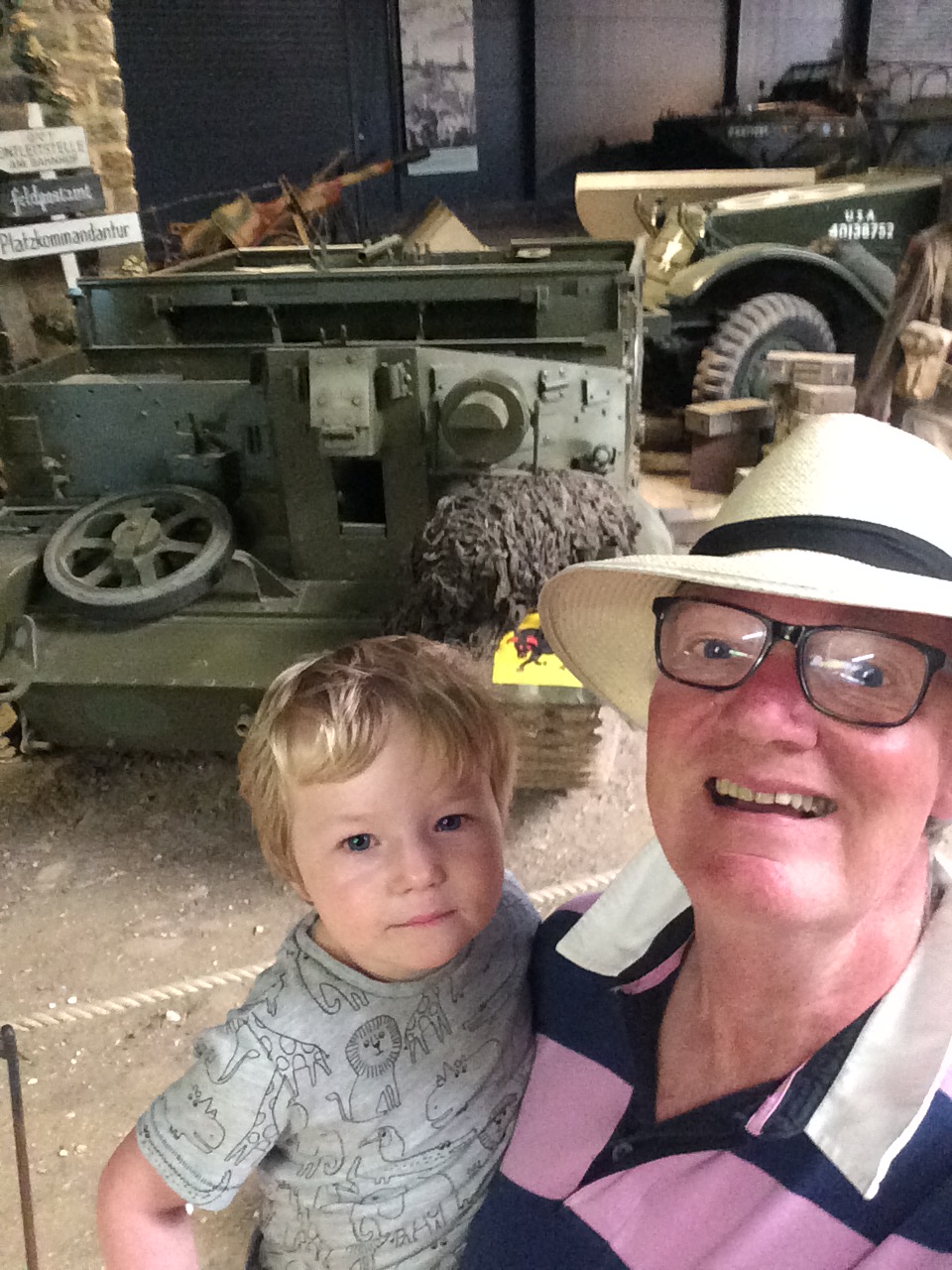
A slightly pregnant Lucy came across to England during the summer and spent some time with her mum and with us. It was the first time Arthur had been to Thorney and he loved the garden and Holly. We took him to soft play at Crowland garden centre (Julia and Aureliano’s favourite) and also to Duxford. He’s fascinated by aeroplanes, but the most fun was had with one of those iced lollies in a cardboard tube. You know the ones – you squeeze the bottom and the lolly pops out of the top. Arthur squeezed the bottom and when the lolly popped up he thought it was hilarious. Of course, that made us laugh and Arthur laughed even more. Who would think there was so much fun in a Calipo? You can judge for yourself at: https://youtu.be/i2DQGsqUDxU. Here's a picture of Arthur and I in front of great-granddad's tank. My dad drove a universal carrier across Europe loaded with heavy machine guns and mortars. It's no Tiger and Arthur wasn't massively impressed.
Our house is busy … briefly
For around three months at the start of the year, we had Tom, Lucy, Julia and Aureliano living with us. They are now in Ecuador until September 2019, while Lucy completes fieldwork for her PhD. Their lease ran out just after Christmas, so it wasn’t possible to get a short lease to cover the gap. It was really nice to be able to spend so much time with them. Margaret enjoyed trips to town on the bus with Julia, my sister took her to Rhyme Time at the library and I was a regular at the Mums and Toddlers group at the Bedford Hall.
We thought Aureliano would walk before he left for Ecuador, but he was quite happy crawling, climbing and standing. It was fair enough that Nidia and Carlos would get the pleasure of seeing him take his first steps.
We’ve really missed them this year. I wanted to send them letters and stories, but the post to Ecuador is so unreliable and four or five letters went missing. We talk on Skype every few weeks, but it’s not great for toddlers and three-year-olds. I’m sure Aureliano has forgotten who we are.
Aureliano in the high paramo near Simiatug.
Allotment
My allotment has been quite productive. I grew outdoor tomatoes, early/maincrop potatoes, broad beans, onions, cannellini beans, cucumber, asparagus, rhubarb, courgettes, runner beans, raspberries, blackcurrants and chillies.
I also grew sunflowers, lilies and roses for cutting.
We bought a chest freezer this year and that has been a real boon for storing our produce. We had far too many courgettes (what was I thinking putting in eight plants), but there were some success stories. The tomatoes were great. I grew cherry tomatoes in the greenhouse at home (sweet aperitif) and outdoor ones at the allotment (Outdoor Girl). Margaret processed them by roasting and removing the skins and we’ve not had to buy any tinned tomatoes all year.
The chillies froze once sliced and we have bags and bags of raspberries. We froze lots of courgettes and haven’t eaten any yet, also lots of early potatoes. I think they could be used, but really, they’re best eaten fresh or given away.
In 2017, my maincrop potatoes were badly attacked by slugs and I was pleased that this year, there was very little slug damage. It was a very dry year, which reduced slug numbers, but also meant the potatoes looked like finishing early and small. In the end, we had a wet spell and they burst into life again. The harvest was pretty good. We gave some to Max and my sister and we’re still working our way through the bags in the shed.
In 2019, year, I’ll do more tomatoes, butternut squash and also try aubergine. I’ve added Sweet William for cutting.
Max’s back garden
As well as my own allotment and garden, I’ve managed to help Max and Sam with garden work. Max’s new house has a small back garden, which comprised a little patio, grass and various shrubs which had become rather large.
New planters and slate chippings in Max's garden
We removed a tree and a couple of shrubs, built four raised beds and put down slate chippings across the old grassed area. We had to do it during the wettest week of the year and the ground was absolutely saturated. Annoyingly, that was the last real rain for months and we had the driest, sunniest summer I can remember. Our work looked pretty good, especially after Max painted the raised beds and they were planted up.
The only problem was that he bought a whippet puppy (Ollie) https://youtu.be/mPDoU5iykt4 and then, later in the year, acquired Ollie’s brother Archie. The two whippets have caused some mayhem by jumping from bed to bed and we’ll have to carefully think through our planting plans for this year. What plants can you get that are whippet-proof?
Sam’s allotment
Sam got himself an allotment at Grouville in spring. It’s some way from his house, but a lovely spot overlooking Gorey castle. He’d done some work on it during the early summer, but with a lively two-year-old and new baby on the way, he was fearful that he wouldn’t have time to look after it.
One of the problems was that he couldn’t take Arthur up there without full-time supervision because there were so many dangerous things lying about. When we went across in August, he’d pretty much made up his mind to give it up, so I went to have a look at it with him and said I’d help him get it into shape. He wanted to create some terraces and raised beds and I said that we could put down sheeting over land that wasn’t being used to suppress the weeds. Some spray with weedkiller twice a year would keep it on order.
Sam's newly tiered, sheeted and barked allotment.
In autumn, I went over for a week and we worked on it together. We created two terraces, with steps down from each, I relayed the flags at the top to even up that area, we put in three water tanks with a rain-collection system off the shed, built three new raised beds, three compost bins, fenced the bottom and spread bark chippings across the whole second tier.
It looked really good and when we took Arthur along to see out handiwork, he immediately jumped off the highest point of the top level. Thankfully, the chippings are a soft landing. I hope they’ll get good use from the plot in 2019.
Cars and motorcycle
I’ve had a motorcycle since my mid-life crisis more than 20 years ago, but I seem short of time, don’t have any riding companions and I’ve felt more and more vulnerable on two wheels.
My BMW R1200ST - I hope it will clock up more miles
This year, I bit the bullet and sold my BMW R1200ST. A German doctor from London bought it and has great plans to go touring. I hope he enjoys it and manages to put more miles on it than I have.
2018 also saw the end of my BMW estate, which I’ve had since 2009. It had almost 250,000 miles on the clock and I sold it to Andy Bunyan for £500. I said I would drive Tom’s Ford Mondeo while he was away in Ecuador. It’s not worth a great deal, so he’d have lost money if he’d sold it and then bought another when he got back. Also, he had nowhere to store it.
It was suffering from a number of dents and scratches (he seems to have become very crashy this past year) so I spent the £500 from the BMW on getting the Mondeo tarted up.
After my last Mondeo and some terrible after-sales service from Ford, I vowed never to have another. I had to take Ford off my blacklist to help out my son – there’s a good dad (my blacklist is very precious to me).

Ford Mondeo - I didn't think I'd own another of these.
Out and about
We’ve been on a few trips with Probus. Early in the year, I visited St Andrew’s Church, Woodwalton (Margaret didn’t come for some reason, I can’t remember why). I used to see the church every day from the train on my way to London. It stands on a small hill and seems to be miles from anywhere. It used to fascinate me.
It is some distance from the village and our walking group started from Woodwalton, walked across fields to the church, where we were shown round by a local volunteer. It’s now managed by the Friends of Friendless Churches and is kept locked most of the time. It was a nice walk and great to visit this place which was so familiar to me for so long through a speeding train window. Margaret, my sister and I visited it again on New Year’s Day, but were not able to go inside this time.

We had an interesting visit to Southall Minster and the town workhouse. Now here’s a place, we would never have visited if not for an organised trip. Southall is in Nottinghamshire and I’d heard of it because there’s a racecourse there. It is a really historic place with a magnificent minster church. We had a guided tour, so found out lots of things that we wouldn’t have known just by wandering around. The stone carvings were amazing, so detailed and intricate, with detail that wouldn’t be seen unless you looked at them from certain angles.
The workhouse is perfectly preserved and owned by the National Trust. It was an interesting trip, but pretty depressing stuff. I’m sure it did its job and did help a lot of people – but it could have done so in a much more Christian way (perhaps Christian with a small C).
Intricate carvings in Southall Minster. Pigs eating acorns under oak leaves.


Our other notable trip was to the Crown Derby pottery factory in Derby and to Kedleston Hall, just outside Derby.
The pottery factory was small, but busy and we had good access to all the various processes. Lord knows how they’re doing in the midst of the Brexit mess this government has created. Margaret and I had enjoyed watching a BBC series called The Great Pottery Throwdown, where craft potters compete to win a prize, so it was interesting to see the techniques we’d learned about in that programme in a commercial setting.
They had moulds and a machine to stamp out plates of a consistent size, but the raw clay plate seemed huge. Once it’s dried and then fired, it shrinks by a huge amount (to normal plate size). That’s true of everything they make, so things with lids, like teapots or jars, have to be made oversize to the right proportions, so that they shrink in proportion and fit perfectly after firing.
A lot of decoration is added using transfers, which is skilled, but not as skilled as the hand-painting which is used only for the very special, commissioned pieces.
Lady Curzon in the Peacock dress
Kedleston Hall was owned by the Curzon family and the most interesting member was George Curzon, who was Viceroy of India from 1899 to 1905. He was a dyed in the wool imperialist but one good thing he did for India was to save the Taj Mahal which was falling into disrepair. It’s now one of India’s main tourist attractions, so thanks for that George.
He also did his fair share of shooting tigers and riding around on elephants. Like many British aristocrats, he bagged himself a rich American wife (Mary Letter). In India, they were something of a golden couple – the Posh and Becks of their day – and the crowning glory was Mary’s appearance in the Peacock Dress for the 1903 Delhi Durbar to celebrate the coronation of Edward VII.
The dress is now in the hall (and owned by the National Trust) and there’s also a painting of Mary wearing it. The dress is described thus by Wikipedia: “The gown was assembled from panels of chiffon that had been embroidered and embellished by Delhi and Agra craftsmen using the zardozi (gold wire weaving) method. It was then shipped to Paris, where the House of Worth styled the dress with a long train edged with white chiffon roses. The worked panels were overlapping peacock feathers that had a blue/green beetle wing at the center. Over time, the metal thread in the dress has tarnished but the beetle wings have not lost their luster.”
Votes for women? Never, said Lord Curzon.
Sadly, Mary died quite young (36) only a year after their return from India. George had a high-level political career, but seems not to have been a good politician, managing to upset as many people as he charmed. His final big campaign was to lead the campaign against women’s suffrage and there’s one of his campaign leaflets in the hall, which makes interesting reading. If he was alive today, he’d have been a rabid Brexiteer, a leading light in the European Research Group.
Books
One of my new year resolutions was to read more books. I managed just two, although I did get through quite a few Spanish text books. Those I read were:
Feral by Geoge Monbiot.
This is a book about our landscape and environment. It challenges many of the commonly accepted ways that land (and sea) is managed. For example, Monbiot doesn't believe that sheep grazing of the English and Welsh uplands produces a beautiful and sustainable landscape. He presents a very convincing case for reforestation of our uplands and for re-introducing a number of species which once lived there, but were driven to extinction by the activities of man. It's a challenging read and makes you question everything from the system of farm subsidies, why we allow vast tracts of Scotland to be owned by absentee landlords to why we allow unsustainable fishing. The book destroys any faith you might still have in the competency of politicians (especially Welsh ones) and I ended up shaking my fist at the TV during a BBC Countryfile story on sheep and hard-working hill farmers. I now view sheep as evil tree destroyers – a grey plague on our landscape.
To See Every Bird on Earth by Dan Koeppel
Do you know how many types of bird there are on earth? It's probably around 15,000, but keeps growing and shrinking as species are split into sub species and sub species are lumped together into single species. Whatever – it's a lot of birds. Dan Koeppel's book is about his father, his father's life and his relationship with him; it just happens that Koeppel (senior) is a keen birdwatcher. In fact, he's a particular kind of birdwatcher – a lister – someone who sets out to see as many different birds as they can. There are a very small number of people who have seen more than 7,000 birds and, when the book was written, the record stood at just over 8,000. It's a really interesting book and has prompted me to list all the different birds I have seen. It’s only around 100.
Theatre
I didn’t go to the cinema once during 2018. It’s hard to get Margaret out in the evenings and last time we went to the cinema, she fell asleep. We did see a number of things at the theatre, however:
Andrew Rieu in Maastrich at Stamford Arts Centre. This was a live link to his early evening performance and it is the second year running that my sister has bought me this for my birthday. In 2017, we went to the Lux at Wisbech and I enjoyed that more because you say on a huge settee and could drink wine during the performance. It was good though and we had pizza and wine before the show.
Carmen the Gypsy. We saw this at the Key. It should have been in the main hall, but so few tickets were sold that it was relegated to the studio. This meant we were right in the faces of the actors and it was an incredible performance, probably the most intense experience I’ve had in a theatre. The cast were brilliant and it was a real privilege to see such good acting at such close quarters.
Tangomotion was another Key Theatre excursion. It was an evening of dance with a band and two couples. The band leader gave some insights into the tango and explained the different types of dance. It was very enjoyable and I also learned what a bandoneon (previously seen in Spanish poetry) was. It’s a type of accordion and makes that particular tango wail.
Adam Kaye, This is Going to Hurt (back in the Key). I thought this would be a jolly comedy and it was funny, but the ending of the show was a real stunner. His book is in the top 10 paperback non-fiction and it deserves to be.
McGuinness and Whitham. We saw Foggy and Whitham at the Cresset a few years back and this was in a similar mode. The key was busier than I’ve seen it for anything other than burlesque. It was a good night and we won a copy of John McGuinness’ autobiography in the raffle. Maybe that will be one of my books to read in 2019.
Albion Christmas Band. This was our Christmas present to my sister. We saw them at Stamford Arts Centre a couple of years ago, but they were much better at The Key and we had a fantastic view from the second row. Really enjoyed it.
 Things I've done for the first time
I have this idea in my head that it’s important to keep having new experiences and trying new things to keep my brain sparking. It gets harder each year to find new experiences. Here’s some from 2018 …
Went to Tenerife. I’ve been to the Canary Islands before (to Fuerteventura) but this was my first time on Tenerife, the largest of the Canary Islands. The Canaries are volcanic, rising from the floor of the Atlantic and there are still active volcanoes, including the 12,000ft high Mt Teide on Tenerife.
We stayed at Adeje in a five-star hotel and barely left the hotel during the entire fortnight. We’d gone with Sam, Lucy and Arthur, so it was a chance for us to spend some family time together. We’re going back in 2019, so it must have been a hit!
Drove a hybrid car. Global warming is the biggest threat to humanity in the next 100 years. What are we doing to reduce emissions of CO2? Nothing much – emissions are increasing as the world population rises and China and India industrialise. We have signed up to various commitments and the UK will reduce carbon emissions. Cars like the Hyundai Ioniq (70mpg) help a little I guess. I hired the car to pick up Bert and Irene (near neighbours) from Kent where they were dropped after a holiday. Bert recently had to give up driving after some memory issues.
Went to Southwell Minster, Crown Derby, Kedleston Hall and Woodwalton Church (see above).
I became a Member of a MAT (Multi Academy Trust) so I find myself working with officials of the diocese of Peterborough and various vicars – it’s a MAT sponsored in part by the Peterborough diocese. I’m not sure if it will ever fly. In true church tradition, we just get something agreed and everyone falls out. We started the year with six schools and ended with two. If we can’t find at least one more, we’ll get the chop by the DfE.
I became secretary of Peterborough Probus 02 (a club for retired businessmen and professionals). An extra job was the last thing I needed, but it’s not too much work and when I unload some jobs, this will probably be one I keep.
Max with Ollie the whippet puppy.
Max got a whippet puppy (quite a handful) and then adopted its brother as well. One whippet is a handful, two are a double handful. It’s my first experience of the dog and they are sooooo fast. They’ll get across a field in a few strides, they seem to fly across the ground. They make Holly look rather old and slow (which she is, in comparison).
Here’s one thing I never expected to do – I played Warhammer. This is Max’s new hobby and, like all of his hobbies, his enthusiasm is overwhelming. He has hordes of alien armies sitting in his garage and I’ve teased him a little about it. Anyway, he brought his kit over one weekend, so I could have a go. I did enjoy it, mainly because it was a chance to spend some time with Max. He has got very good at painting tiny models.