Monday, 27 August 2012

Save the Suffolk newts

Spaldings Farm, Framsden, Suffolk - our holiday
home for the week
We’re on holiday in Suffolk this week, staying at Spaldings Farm, Framsden, near Otley. It’s a really nice old place, timber framed with a thatched roof and clearly very old, although much modernised and renovated.

It seems odd to have a thatched farmhouse with mood lighting in the garden, flat-screen TVs in almost every room, full switchable stereo with outside speakers, electric gates and CCTV, but I guess that’s how things need to be.

Anyway, the place is lovely (as you can see from the pictures) and there’s lots of room. The grounds are about three acres and are fully fenced, which is why I got the place, so that the dogs could run around without getting into too 
much trouble. However, we didn’t bring them in the end because Margaret was worried about them making a mess. It’s a tough call, but as it happens, I think they would have been fine and, of course, we’re missing them like mad.

The place has a massive kitchen with all mod-cons, including a double-door fridge with wine cooler and a freezer with an automatic ice-making machine. Ice-making machines are the best thing ever - this one is plumbed into the mains, so that it just keeps making ice like the magic porridge pot kept making porridge (although this has a sensor so that it stops when the drawer is full). That would have been an ideal adaptation for the magic porridge pot, although sensors would not have been a regular feature of life when that story was concocted and they would have rather spoiled the plot.

We were a little worried to find a massive Aga sitting in the kitchen. They are the most stupid of appliances - great when it’s cold and they make the kitchen cosy, but having to have the thing kept on when the outside temperature is nudging 30 deg C and the kitchen is like a sauna is not good; also it is our only means of cooking (apart from microwave and barbecue), which means that we had to master Aga roasting - a dark art which can take years of trial and error to become proficient. Fortunately Tom managed it in a morning, so our chicken dinner on Sunday was saved.

We all arrived quite early on Friday and had a good look around the place. There are four bedrooms - two with doubles and en-suite bathrooms and two twins with a shared bathroom. There’s a big kitchen (complete with the Aga), a playroom-cum-sitting-room just off the kitchen, a laundry room, a snug with leather chairs and a massive open fireplace, a large dining room with woodburning stove and a large lounge with another massive woodburner. Outside there are three acres of land, lots of lawn, two patios, a play area with trampoline, a pond, a part-built swimming pool, wildlife area, orchard and a big drive with turning circle and double garage.

Friday was scorching, so we sat outside, drank G&T and then tucked into bread and cheese for supper. Tom and Hannah were here quite early, but Max and Inna couldn’t set off until later when Inna was home from work, so it was about 10.30pm when they got here. I’d had the usual rush to try to get all my work cleared before going away and, as usual, I hadn’t managed it. I got up at 6am to get some clear, leaving just one job to squeeze in somewhere over the weekend. We went to Whittlesey to stock up on groceries (I’d bought the cheese from Pimlico on Thursday) and then I had to take Holly and Gravel to kennels. They thought they were going on a walk across the Fen when Margaret put their leads on and Holly was a bit disappointed to be shown the boot of the car. Anyway, I got them dropped off at Chestnuts Farm and then packed and we set off at about 1.30pm.

We had so much wine, beer and food, that the car was jam-packed. If we had decided to take the dogs, we‘d have needed to make two journeys!

Saturday was a scorcher - hot and very sunny. Tom and Hannah wanted to go to Aldeburgh and set off for the seaside mid morning. We said we’d follow along and visit a few towns on the way as Max had forgotten to bring a pair of shoes (how can you forget to bring shoes?) so he was just wearing flip flops. We started off at Framlingham and did manage to get a pair of white trainers (very cheap and very white). Max takes a size 12 and I don’t think there was a lot of choice at that size. As it happened, I don't think he wore them more than once, so probably could have got away with just the flip-flops. Inna (allegedly) had eight pairs of shoes, so she was prepared for almost all eventualities.

Framlingham is a nice place. There’s an old castle at its centre, built at the highest point of the town and a old church with some 13th Century wall paintings. After getting the shoes, we parked up and then went for a walk around town. There were a few interesting shops, quite a lot of antique shops and a small market. I wasn’t very impressed with the market stallholders. The veg man was messing around re-arranging his produce while people were queuing to be served and the woman running the cheese stall was talking on her mobile all the time. I went up to take a look at the varieties on offer and she glared at me, almost challenging me to dare to ask a question so she’d have to interrupt her telephone conversation. Had she engaged me, instead of the phone, and offered me a couple of tastes, I might well have bought some more cheese.

After Framlingham, we headed for Saxmundham, which is in the general direction of Aldeburgh. It was baking hot. On the way, there was a village with a summer fair and a dog-agility competition, which might have been good, but we couldn’t see where it was on or where we might park.

Saxmundham is a fairly big place, but not exactly thriving. It’s like so many English market towns. The market is long gone and the centre of population now works in random pursuits or drives to Ipswich (I guess). It was nice enough, but a bit run down and we were not having much luck finding somewhere for a late lunch. Eventually we discounted the expensive (and not very nice looking hotel and went into a vintage market which was advertising tea and cake. Turned out not to look very appetising either and so we came out debating where there might be to eat. The chap selling plants outside suggested the bistro over the road, which turned out to be a good choice and we had a nice lunch. I had raspberry and coconut slice and a bottle of elderflower presse. After lunch, it seemed so hot that I floated the idea that we abandon Aldeburgh and head home for beer and chillaxing. Everyone must have been thinking the same thing - I’ve never seen such an enthusiastic response!

I was going to make pasta and cream sauce for dinner, but Tom wanted a barbecue. It sounded like a good idea actually and so we had chicken and sausage with veggie sausage and burgers for Tom and Hannah. It’s scary how quickly we’re getting through the booze. After dinner, it was such a warm night that we sat outside and watched the sun go down on the front patio. You could see the Milky Way quite clearly as there was no light pollution and no Moon and we also spotted a few random shooting stars in the dark sky. My minor triumph was working out how to open the window in my bedroom so it was a little cooler.

Sunset at the front of the farmhouse.

On Sunday, the weather was just as hot as it had been the previous day. From early morning it was too hot to sit in the sun. Pauline and Chris were driving down to spend the day with us and they arrived just before noon. This is a great place for entertaining because there is lots of room and also lots of different rooms, so you could lose people in the house quite easily.

It does mean that you can spread about, always find a quiet room and never feel too crowded (except in the kitchen at breakfast).

We had thought about taking a walk, perhaps to Framlingham, but everyone thought it was too hot (it was!) and so we spent the day sitting, talking and drinking. We had popped across to Stowmarket in the morning to stock up on food and Tom took charge of the cooking, which was a good thing because Margaret was not going to bond with the Aga and a half-cooked chicken disaster was looming.

We had two chickens, salad and roasted vegetables, with Linda McCartney quorn roast for the veggies. There was sparkling wine; also red and white and cloudy lemonade for Pauline, who was driving. Chris doesn’t realise how lucky he is having a wife who likes driving. We basically sat around all day enjoying the sun, trying to find shade and drinking.

In late afternoon, Tom came to the front patio to say there were newts dying in the part-built swimming pool. Max went round to see what was happening and came back with a couple of newts in a bowl, which were released into the big pond. After Pauline and Chris had gone, we mounted something of a slightly drunken rescue operation. The swimming pool was fully excavated and concreted, but not tiled. Rainwater had gathered in the deep end and, at some point, newts had got in there and bred. They’d clearly done quite well because there were lots of them, but now they had reached adulthood, they should have left the pond and been feeding on land. Trouble was they couldn’t climb the sheer walls of the pool and the hot sun meant they were literally baking on the concrete as they struggled.
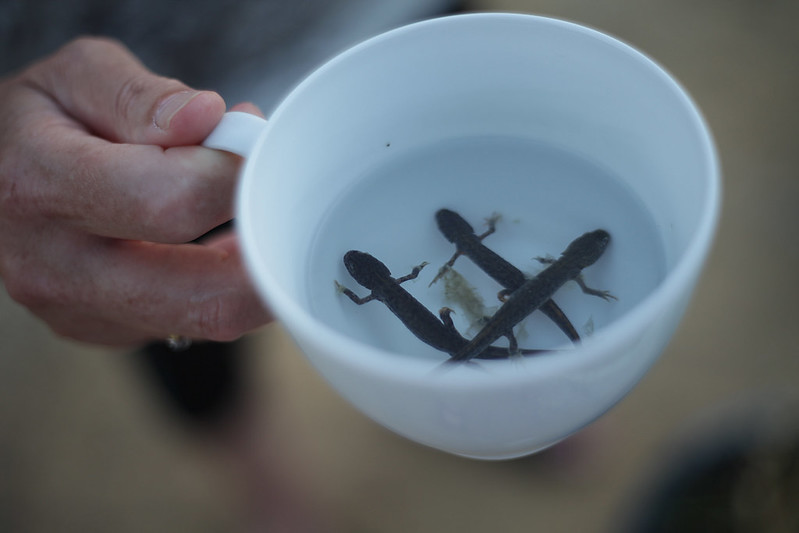
Rescued newts ready for release next to the big pond.
We managed to scoop up about a dozen and then I constructed some newt ramps from lengths of wood found in the garden. After dark, I phoned Suffolk Wildlife Trust and left a “Save the Suffolk Newt” message on their answering machine. I fondly thought that there would be an army of newt rescuers round the next day complete with waders, nets and buckets. In fact I got a call from some young lass who said the newts shouldn’t be in the water at this time of year and I didn’t need to put them in water.

I said thank you and would someone be coming to help save the newts. She said we were doing exactly the right thing and it was quite all right to take them out of the pool where they were trapped. It seems the Suffolk Wildlife Trust is more interested in drinking coffee and worrying about where its next grant is coming from than rolling up its sleeves and putting on its wellies. Anyway, we were on our own.

Well not exactly - I’d also e-mailed the letting agents and told them the owner was allowing the slow and painful death of an endangered species, a rare colony of great crested, lesser spotted newts. I said bypasses had been diverted to save these poor creatures and here they were being baked alive in a half-built swimming pool. I had taken a drink or two! Anyway, a very nice chap from the letting agents phoned on Monday morning soon after the useless lot from the Suffolk Wildlife Trust and he sounded very concerned. He said he’d tried to call the owner, but thought she might be abroad and he’d get the cleaner to send somebody round to check it out.

While we were out for the day (in Southwold), I got a call from the cleaner, Karen, to say her partner had been round and the newts had gone. I feared the worse, a pogrom of newts.

When we went got back in the late afternoon, we went down to the pool and couldn’t see any newts. I had bought a net from the seaside so we could mount a more efficient rescue operation later that day, spending £1.99 on the best that Southwold Pier beach shop could supply. But there were no newts to net - the pond was bare. And there were no bodies either, no sign of a massacre. It seems my newt ramps had done the trick and the whole colony, under cover of darkness, had taken the opportunity to migrate. There was something wonderfully Biblical about the whole thing.

My sister Margaret had arrived late morning to spend a day or so with us and she must have thought we’d gone barking mad building newt ramps in half-built swimming pools. Is this what her brother gets up to on holiday - well yes it is actually!

Maggie was going to stay overnight and was very taken with the house. She said she’d like to spend her 65th birthday here and was very content to sit around in the sunshine reading her book. Around lunchtime, we set off for Southwold in the BMW with Maggie, Tom and Hannah. Max and Inna had gone to Aldeburgh on their own.

I was a little disappointed with Southwold and even more disappointed to get a speeding ticket driving out of town in the afternoon! I’d expected something a little more chocolate box/Cornwall pretty and the north part of the town where we parked is dominated by its pier and a scruffy car park with model boat lakes on the reclaimed land behind the sea wall. Erosion is a major problem along the Suffolk coast and Southwold has impressive concrete bulwarks and a network of groynes to hold onto the sand.

Tom was keen to have a swim in the sea so we walked north along the beach which extends way up the coastline in front of low cliffs. It’s actually a very nice beach, but we were near high tide so there was not that much of it available. Away from the scruffy car park and the scruffy pier, the land rises and you can walk up into the town, which is quite nice. I suspect it’s nicer still down towards the harbour, but we didn’t get down that far. Tom and Hannah were on a mission to find somewhere to eat and were not reaching a consensus on where that would be. I bought a few bits and pieces for a barbecue that evening from a somewhat grumpy Co-op store. It’s strange that the small stores always seem to be staffed with miserable, grumpy people. It’s the same with Tesco Express, I find. Perhaps the Southwold Co-op is run by the same family that has the cheese stall on Framlingham market?

Monday night was yet another barbecue - we’re certainly getting good value out of the little Weber they have for our use. The only disappointing thing is that they ask for you to barbecue on a small paved area some way from the house. I guess it’s to try to preserve the thatch and, if you own a thatched property, you clearly become paranoid about fire (with good reason, too). It does mean that the cook (me) is somewhat remote from the table conversation (and wine) and needs a string of runners to carry food back and forth.
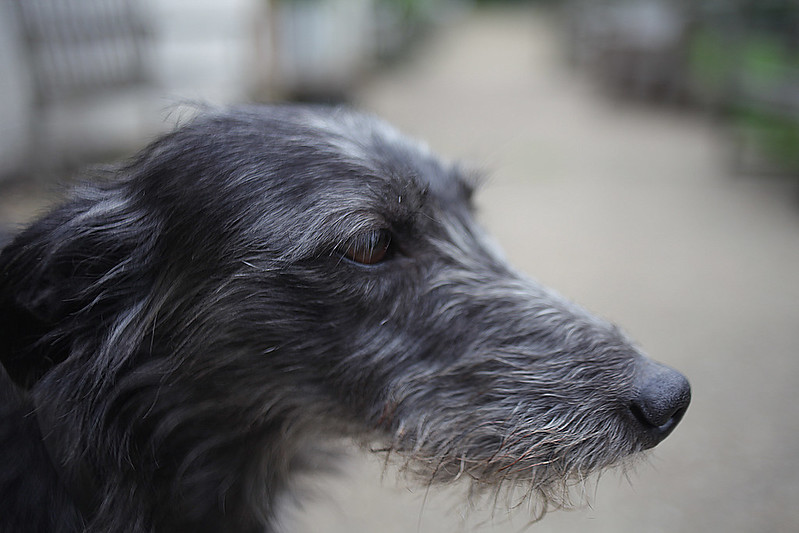


Midge - the vineyard rabbit catcher

On Tuesday, we planned to visit a vineyard that Tom had found on the internet. It was called Gifford’s Hall and was at a place called Hartest, about 30 miles away. We could combine that with a visit to Lavenham on the way back. We hadn’t planned an early start and my sister was going to head home after lunch when we went to the vineyard. I called them in the morning to check that they were open and it was a good job I did because they were not expecting visitors and normally did vineyard tours only at the weekend. However, the person I spoke to (who turned out to be the owner, Linda Howard) was very keen that we went and said we could come at 2.30pm after lunch.

It was further than we thought and there were no brown tourist signs to tell you where the place was, just a little home-made sign saying Vineyard. When we got there the gate was locked, there was no-one around and the place looked a little bit scruffy. I called the number from my mobile and this time I got Guy Howard, the owner (and Linda’s husband). He was full of apologies, his computer was giving trouble, there was someone in doing the books and he’d forgotten to open the gate. He was round to the side pretty smartish and let us in.


Not a good start but the place was charming. It’s a family-run business by Linda and Guy Howard and they clearly love what they’re doing. Linda took us around the vineyard and told us a bit about the grapes before leaving us to it. Husband and wife (especially Linda, who is very charming) are involved right across the business from looking after the grapes to making the wine, marketing, delivery, etc. Midge the dog (a hairy whippet lurcher), whose job is to keep down the rabbits, accompanied us on the tour. The grapes are Bacchus and Madeleine Angevine; also some Pinot Noir. They are grown in small fields surrounded by hedges of trees to protect them from the cold wind. The vines are trained along lines and I suspect they’re a bit like blackcurrants in that the fruit grows on stems formed the year before. The vines were very prolific and many had thrown out runners and tendrils across the spaces between rows. The grapes were still quite small (pea-sized) but there was plenty of fruit on the vines and Linda said they’d get enough for 50,000 bottles of wine. Back at the office/shop, we had a tasting and the Bacchus wine was particularly good; we also tried their red (light, fruity with a hint of smoke) and their rose. They also make some liqueurs (raspberry and apple) and we ended up with two cases of wine and a bottles of raspberry liqueur. It was a really nice trip and we tucked in to some bottles back at the farmhouse that evening.

On the way home, we stopped off at Lavenham which is an amazing place and well worth a visit. It also has a free car park (near the church - how good is that). Lavenham was once one of the richest places in Britain (in the top five) with its wealth derived from wool. The result was a lot of fine mediaeval houses and, because the place fell on hard times, there was a make-do-and-mend policy rather than knock it down and build something better. So no grand Georgian, Edwardian or Victorian homes, just the biggest collection of mediaeval buildings in the UK. It’s wonderful to see, although the fact that none of them have driveways or garages, means that the views of the houses are somewhat spoiled by the Peugeot parked outside. I guess it would be impossible to keep cars out of Lavenham, although it would look much better for it.


Views of Lavenham by Tom Rayner


On Wednesday we went to Sutton Hoo, which is just across the River Deben from Woodbridge and very close to us (less than 10 miles away). It’s one of the most important archaeological sites in the country having given us valuable insights into the sophistication of pagan society, the surprising extent of Saxon trading activity and unearthed the richest treasure found in the UK.

Sutton Hoo is on high ground and in the 1930s the woman who owned the land asked a local archaeologist to excavate the burial mounds on the site. There were two large mounds and lots of smaller ones and in the smaller ones they found a number of examples of burials with boats (small canoes in these cases). One larger mound had already been partly excavated or robbed, but the other appeared to be untouched. What they found there was a massive ship burial, similar to sites in Sweden. They buried the ship below ground level, with a cabin constructed on the deck to hold the body and his earthly treasures. They then buried it and constructed a large mound on the top. Because of the acidity and the free-draining nature of the soil, everything organic rots quite quickly, so nothing was left of the boat except an impression in the soil (almost like a fossil) and hundreds of rusting iron rivets which would have held together the planks. The treasure (the buried person’s possessions) included a helmet inlaid with gold and silver, a fabulous purse and shoulder clasps, bronze bowl, sword and shield with rich inlays and a stag standard. The metalwork in the pieces was far more sophisticated than the Saxons were thought to be capable of and some of the precious stones were imported from what is now Turkey and the eastern Mediterranean.

All these have gone to the British Museum and there are replicas in an exhibition area at Sutton Hoo. I’ve seen the artifacts in the British Museum and they are amazing, but it’s still more amazing to stand on top of the burial mound and see the two stakes marking the prow and stern of the ship, which was much larger than I’d thought and had been dragged and manhandled up the hill from the Deben below. It was around 60 feet (20 metres) in length, would have been seaworthy and would have had 20 oars a side, plus a sail for the open sea for use when the wind was in the right direction (these ships were square rigged and so would not have been able to tack and sail against the wind. When they were excavating the ship, they found evidence of an attempt to rob the grave and the reason it failed was because the front of the mound had been ploughed away over the years and so, in Tudor times when the mounds were opened for the treasure to be taken, they miscalculated the centre of the mound and found nothing.

It was a lucky escape and I couldn’t help but think that it was a shame that the main mound had been opened in 1939 and not today when we would have had a much different approach, better techniques and would have discovered far more about the site.

Grave robbers had cleared out the other large mound, but later archaeological work confirmed a ship burial almost as large as the one uncovered in 1939. They also found a burial side-by-side of a Saxon warrior and his horse. Robbers had missed this treasure because the two were buried a little way apart and their usual technique of digging straight down from the centre of the mound had gone between the two bodies.

It was a lovely day and our guide did a good job explaining everything. It was also enhanced by a very old lady in the tour group, who was struggling to walk and keep up, but who remembered the news about the Saxon treasure being unearthed when she was a little girl. It was clearly big news at the time and she had always wanted to visit the site. She was so interested and so excited by everything and she must have been at least 80.

So who was buried at Sutton Hoo? No-one knows for sure, but the consensus is that the main grave is that of Raedwald who was king of the east Saxons in around 600-630. He was the first Christian king of the east Saxons, but he maintained a pagan shrine and his wife and advisors would not convert. One theory is that his grand pagan burial was a last huzzah for Wodin before Christ took over. The warrior/horse burial may have been that of his son, Raegenhere, who was killed in the Battle of the River Idle near modern Bawtry in East Yorkshire. The other ship burial may have been his father Tytila. Sadly, we know little about Raedwald. What we do know is from Bede and written around 200 years after his death, so it’s an educated guess that he was buried at Sutton Hoo. Documents which may have confirmed that would have been lost in subsequent centuries when the monasteries of East Anglia were raided and destroyed by Vikings.

We had been planning a trip to Aldeburgh all week and, as Thursday was our last day, we decided to make this Aldeburgh day. Tom and Hannah had been on our first day and Max and Inna had gone on Monday. Aldeburgh is very much in the mould of Southwold, but has a shingle beach, and it is a nice place to wander around. It has a real, old-fashioned feel to it. One nice feature is that there are lots of shacks selling local-caught fish, including a decent amount of line-caught. Nice to see sustainable fishing in at least one part of Britain.

We stayed at Aldeburgh for lunch and then popped in at Framlingham on the way home. We’d been there on Saturday, but hadn’t had time to look at the castle, so on our last day Tom and I were going to have a quick look around, while Hannah and Margaret had a look around town. Funnily enough, Max and Inna had been visiting Orford Castle on the coast and, on a clear day you are supposed to be able to see Orford from Framlingham (and vice-versa, of course). Framlingham is a castle built of a curtain wall with connecting towers, quite unusual. It was built in the 11th century by Roger Bigod and has had a fairly quiet life. It was besieged and taken by King John in 1215, but that was about it. By the time of the Civil War it had become a poor house, which meant it posed no threat. This is a ruin that Cromwell had not knocked about a bit. The most interesting thing is that it was owned by the Howard family, one of Henry’s courtiers and the family of Catherine Howard and Anne Boleyn (both beheaded). It was also the site where Mary I was declared queen of England.

You can walk around the battlements and there are good views of the town and the countryside. To the north there’s a mere, which would have been used for fish back in the day and was much larger than it is now.

Back at the farm, there was time for one last barbecue and it was time for home in the morning. Suffolk is a really good place for a holiday. It’s only two hours drive from us and also pretty easy to get to from London. I really liked Spaldings Farm; it had lovely grounds, lots of character and there’s plenty to do for a week.


Tuesday, 14 August 2012

End of the Olympics

So that’s it, no more Olympics for another four years. The games are over, it was the closing ceremony last night and we’ll all have to find something else to talk about.

I have to say that the games have been splendid and have made everyone, except the Scottish Nationalists, proud to be British. I even feel a little grumpy about having complained that my routes into work were disrupted. I haven’t taken a bicycle from King’s Cross to Victoria for a couple of months, since they closed the Mall and Horse Guards Road and made me cycle through Parliament Square to get to work.

When London was awarded the Olympics and it was announced that beach volleyball would be held at Horse Guards I thought that would be quite nice - I could have a look at it as I went past. What an idiot! You couldn’t get within half a mile of it, let alone have a glimpse of the court. It has been interesting to see the Olympic park in Stratford gradually develop. Tom and Hannah were living in Bow for three years during the building work, so when we went to see them we’d drive down the A12 alongside the park and you could see it all taking shape.

It’s funny, but as soon as we won the Olympics, the bad news started and it didn’t seem to stop until the opening ceremony took place. The day after the euphoria of London being selected, muslim extremists blew up three tube trains and a bus in suicide bomb attacks, killing more than 50 people and injuring far more. A fortnight later, another four attacks took place, but the bombs failed to detonate; then police shot dead some poor Brazilian who had been mistaken for a bomber.

We also had the predictable cost escalation. The government had forgotten to include VAT in its cost calculations - that added 18 per cent to the costs at a stroke. We were ready to read the stories about building delays and the last-minute scramble to get it all finished, but that didn’t happen.

Terrorism was a major threat (or fear) and there have been lots of arrests since the bombings, rows about radical clerics preaching hate and periodic bomb scares. For the Olympics, concern about some kind of 9/11 style attack where airliners were hijacked and flown into buildings, led to a squadron of interceptor jets kept on alert, warships anchored in the Thames and, most controversially, batteries of surface-to-air missles sited on the top of tower blocks near to the Olympic park.

Travel disruption was a major concern, with so many people in London, but as it happened, all the dire warnings worried people so much that London was like a Sunday morning most days, with my train and tube journey being much quieter than usual. The tube unions, never slow to strike or grab some more cash, managed to extort massive bonuses for working normally and when the bus drivers tried to do the same, there were bus strikes across the capital.

People complained that they weren’t able to get tickets. I didn’t try because the whole process seemed a nightmare; people complained about the price of tickets; people complained because West Ham was going to take over the Olympic stadium and it would become a football ground, then Spurs and Leyton Orient complained because they claim West Ham had been given special treatment and they also wanted to take over the stadium.

The Cafe Olympic (sorry - Cafe Lympic )
Finally, in the run up to the opening of the Games, there were complaints about the extent of corporate sponsorship, unfair restrictions on visitors and crazy rules being applied. The Cafe Olympic in Stratford, which has been there for 20 years (long before anyone thought of staging the Olympics there) was threatened with legal action because the word “Olympic” was a trademark. The owner just shrugged and changed the name to the Lympic cafe by painting out the O. You couldn’t take food or drink into the Olympic park for security reasons (sandwich bombs) which meant people had to eat McDonalds (one of the big corporate sponsors) and pay £3 for a bottle of water. The fact that they’ve been doing that kind of thing at football and cricket for years should have meant none of this was a surprise ...


There was some trepidation about the opening ceremony. Would we put on a decent show? Would we match the Chinese who had staged the biggest firework display in history four years ago for the opening of the Beijing games? Fears were not calmed when organisers said we were not going to try to compete with China, we had a much smaller budget and the show would be uniquely British.

Word got out that the show would include, ducks, sheep and sheepdogs and fears intensified.

On the night, it was a triumph. The show was organised by film-maker Danny Boyle and the effects were the best theatrical tricks. The stadium included a mini Glastonbury Tor, scenes of rural idyll with sheep, geese, happy villagers, football and cricket. Then there was the industrial revolution with the scene transformed with factory chimneys and forges. A massive Olympic ring was cast  apparently from molten steel and rose into the air to form one of five Olympic rings hanging over the stadium.

There was the story of the River Thames from its source to London, David Beckham bringing the torch and Olympic flame from Tower Bridge to Straford via speedboat and a celebration of all things British - from the National Health Service to children’s literature. The big question was who would light the flame in the stadium and when Beckham handed over the torch to Steve Redgrave (a rower who has won five gold medals), it seemed we had our answer. In fact Redgrave lit other torches, which went to Olympic medal winners, who handed them on to young athletes that were helping to mentor and they lit individual stems on a torch made up of multiple burners - one for each country taking part. The pipes and burners were laid flat on the floor, but when lit, they rose and came together (like a flower closing). It was very clever and very beautiful.

Mary Poppins descend into the area - part of
the celebration of children's literature.
The Olympic torch closed up


Everyone thought they’d done a brilliant job with the opening ceremony and all the negativity around the games seemed to disappear. There was nothing but good news stories (apart from getting the North and South Korea flags mixed up and sparking a diplomatic row, some idiot arrested for abusing diver Tom Daley on Twitter and some drunken yob throwing a bottle onto the track as the 100m final started. Fortunately it was behind the starting line and it didn’t interfere with the final. The chap who threw it was standing next to a Dutch judo competitor and got a chop on the back of the neck for his trouble.

The Olympics are a massive TV experience and the BBC did a really good job. The TV crew outnumbered the athletes on the British team and there were over 20 dedicated Olympic channels. I knew that I wasn’t going to be able to spend much time watching TV, so I thought it best to record a couple of highlights shows late each night and watch those the following day. My Olympics would be a +24 event. Actually, it hasn’t quite worked out like that because I still have 11 shows unwatched, so my Olympics will probably carry on until the end of September.

It was a really successful event for British athletes with 29 gold medals and third place in the medal table behind USA and China. The performance I enjoyed most was Bradley Wiggins (who had become the first Briton to win the Tour de France a week earlier) winning gold in the time trial. Mo Farah did a 10K/5K double and will be a hot favourite for the BBC Sports Personality of the Year. He’s got a terrific story, having come to England as a young boy seeking asylum from war in Somalia.

The Olympics have dominated the news agenda and I felt most sorry for a 12-year-old girl, who went missing on the Monday of the second week. She was from south London, near Croydon, and normally the story would have been headline news. It barely made page 10 and police finally found her body at her grandmother’s house almost a week later and arrested her grandmother’s 37-year-old boyfriend. He’s in court today and at least that gives the news media an opportunity to get back into negative mode. Police have already been criticised for not performing a proper investigation (probably because they were all at Stratford) and for twice searching granny’s pad (including sniffer dogs) and not finding the body. It seems they didn’t think of looking in the loft!

Tuesday, 24 July 2012

Would Zachariah have seen a banana?


Burston now - courtesy of Google
Faden's 1797 map of Burston
When I started my family tree just before Christmas I knew only a little bit about my mother’s side of the family. Now I have names, birth dates and locations going back to the 16th Century for the Broadleys (my great-grandmother on my mother’s side). They were all from East Yorkshire (Beverley way), not far from where I’d worked until moving to London a couple of years ago.

Also, I was surprised, but quite pleased to find that my maternal great grandfather, John Burrows, had been born in Norfolk and I was also able to trace his father, Job and his grandfather (my 3 x great grandfather) Zachariah. They lived in Burston, a small village to the north east of Diss and so while I was on holiday last week I went to visit Burston to walk in their footsteps and to see if there was anything that remained of what Burston would have been like in 1788 when Zachariah Burrows was born.

I also visited Hales and Stockton, home of my great ancestors on my dad’s side. More of that later, but it was interesting that Margaret remarked how much my sister Maggie loves Norfolk. She wondered if something had been passed down in the genes - who knows?

Anyway, back to Burston ... The thing about visiting any village or town and trying to envision it many years ago is that it is extraordinarily hard. If I go back to places I knew 40 years ago, they’ve often changed completely. Around Burston, all major roads will have been straightened, dualled or given completely new routes in the past 50 years. In Burston, it’s a bit off the beaten track, but there was a railway station opened in 1845 (long after Zachariah and Job were born) and closed by Dr Beeching in the 1960s. It was probably the coming of the railway which enabled my ancestor John Burrows to leave Burston in search of a better life. Now, in four generations, it has been opened and closed.

The main Diss to Norwich road has certainly changed course, but not far (and it would never have run through Burston I guess, although it is a more direct route than the current road). Anyway, Burston is now a typical dormitory village with very little industry - still plenty of agriculture, but highly mechanised so that one person and a tractor can do the work of a score of men and horses. There’s an office complex, a pet-food outlet and a millers.

Farmyards will now be housing estates, woods felled for agriculture, hedges planted and then torn up to create larger fields ...

We drove into Burston along Audley End, which is one of the addresses I had for my ancestors, arrived at a crossroad, carried on for a while until we drove out of the village again, then backtracked and returned to the crossroads. Like many travellers, the pub seemed like a good place to take stock. Gravel and Holly were with us, so we treated them to their first pub lunch and, apart from a good old woof when a labrador came through the door, they were pretty well behaved. The pub is called the Burston Crown and a plaque on the front dates it from the 16th century, although the present building was certainly more modern, perhaps no more than 200 years old, but a very nice pub all the same.


The Burston Crown

Perhaps Zachariah, Job and John have slaked their thirst in the bar more than a few times?

There was no longer a post office or a shop in Burston (the landlady blamed Tesco, which she said had not only destroyed all the shops in the village, it was also responsible for half the shops in Diss being boarded up). It’s a familiar complaint, but why do we complain and then shop at Tesco? Why do we elect councils and governments that allow out-of-town supermarkets to destroy our traditional market towns and village shops?

After lunch, we had a walk around the village. It has the usual mix of council houses, built after the First World War as homes for agricultural workers (now in private ownership), some old people’s bungalows, old cottages restored, knocked together and extended, and the modern, four-bedroomed, doubled-garaged ‘executive’ homes you find everywhere. Barratt probably didn’t build them but they look as though they did.

I had few addresses for the Burrows clan. I knew that Job ended up lodging in Church Green and that he’d also lived on Audley End. We started our tour at the church, St Mary the Virgin, which was locked (not a good start), but we had a good wander round the churchyard and failed to spot any Burrows’ gravestones. They would have been buried in there, but probably didn’t have the cash to splash on a fancy headstone. Many of the headstones that were there were overgrown, eroded or covered in lichen, so reading their inscriptions wasn’t possible in many cases. Half the graveyard has been given over to a wildlife conservation area, which is a crafty way for the church to avoid keeping it tidy. The church is not fine - a square building of brick, stone and flint with a single bell housed in an open wood frame on the apex of the west gable. It was built in the 14th and 15th centuries and once had a round tower (typical of many churches in Norfolk) with an octagonal top. Sadly it fell down in 1753 and the church was the subject of major restoration in the 19th century.
 
Next to the Church is Church Green. This is now the site of the Burston Strike School, famous for being the centre of the longest strike in history. Basically, the school teachers were sacked in 1914 and the pupils (with their parents’ support) went on strike. The two teachers taught in a strike school using a tent and the village chapel until a school-house was erected. The strike lasted from before the First World War until just before the Second World War (1939) when the sacked teachers retired. The strike was about the poor conditions available for the pupils; they were cold and, if it was wet, many would have to sit in damp clothes all day. Children were often taken out of school to work on farms if extra labour was needed. The Strike School is now the focus of Labour Party rallies and something of a cause celebre in the union movement.

Job Burrows lived at 26 Church Green in 1891 when he was 72. I guess there was once quite a few houses around the Green, but now there’s just one large modern bungalow and an older house at the west end of the green (which would have been old enough to be around 150 years ago. To the south of the green, there’s a new development - Higdon Close (named after the teachers) which may have replaced older properties. There seems to be the remains of a pond (overgrown and silted up). The Green would not have been there when Zachariah was around, it was created in 1871 when 36 acres of common land in the village were enclosed. I bet that land grab went down well with the locals who would have kept some livestock there.

Audley End is a narrow road leading south towards Scole Common. There’s a small development of bungalows and what look like former council houses near to the village also an office complex in what looks like the old school, but soon you’re in fields with a few scattered houses along the road until you reach the railway crossing. The railway (Norwich to London, Liverpool Street) is still there, but the station, which opened in 1849, courtesy of the Eastern Union Railway, was closed in 1966 thanks, no doubt, to Dr Beeching. Some of the houses along there look as if they could be quite old, but they have been extensively altered and renovated.

I wonder if I had time to wander round, engage some older people in conversation, whether I might find a trace of the Burrows (or even a living Burrows). Maybe that’s a job for another day, we had very little time, two restless Springer Spaniels and several other villages to visit. This was a quick recce and really useful and interesting.

Since my visit I’ve done a little more research, found the names of Zachariah's father and mother, sons and various wives and babies. I’m still inching my way through scanned parish records, 
kindly provided by the Mormon church!

So let’s put a few things in perspective:

Zachariah was born a year before the French Revolution when George III was on the throne, although he was increasingly mad and so the Prince Regent (later George IV) was the power. As he was growing up, Napoleon was rising to power and taking over half of Europe. He was married in 1801 as Britain was at war with France, his first daughter Ann was born the year after the Battle of Trafalgar and was growing up as Sir John Moore’s army was retreating to Corunna and as Wellington chased the French out of the Iberian Peninsular. Job was born in 1819.

In their day, no-one travelled faster than the wind or than a horse could gallop; you could be transported for petty crimes and there was still public execution. There would be no running water in their homes, no gas and no electricity (unless you were struck by lightning). News would be carried by pedlars or (around the village) by word of mouth.

They could not read or write (Zachariah and Job made their 'mark' on their wedding record), there was no cinema, no photographs and no music hall. Sources of joy would be family celebrations, local fairs and the companionship of spouse and family. The church would have been a focus of the community and their fears would have been debt and disease.

Would Zachariah have seen a banana? He certainly would not have - the first bananas (an everyday fruit for us) were imported in 1901.

Burston Church - St Mary the Virgin. Its tower fell down in 1753

Burston Green - they grabbed 36 acres of common land and gave the
villagers a green. Bad deal - I think so, but Margaret, Holly and
Gravel don't care on a sunny day.

Audley End - narrow country lane where my ancestors
lived in the 19th century

Wednesday, 18 July 2012

Go to see Nina Conti

Nina Conti and Monk
Margaret and I watched this absolutely amazing film the other night.

It was called Her Master's Voice - Nina Conti: A Ventriloquist's Story and it was one of the most moving, disturbing and thought-provoking documentaries I've ever seen.

Ventriloquism is an entertainment form that's become a little threadbare. I guess Keith Harris and Orville have pretty much hammered every nail in its coffin and my first memories of ventriloquism came from Lenny the Lion, a really lame children's TV act where you could see the guys lips moving even more than the lion's. The lion (Lenny) also had no padding in his lower body so his back legs just hung loose and floppy. I know rationing had only just finished, but they could have shredded some newspapers to pack his belly.

Anyway, I do have something of a fascination for the art and I had a feeling that this would be good.

Nina Conti is the daughter of actor Tom Conti and she comes across as being a little troubled and emotionally damaged. We'd heard how, as a woman in her early twenties, she'd had an affair with actor and director Ken Campbell (some 40 years her senior) and it was him that had taught her the basics of ventriloquism and got her started. He left her the puppets in his will, including one that was a likeness of himself.

She gave the impression that her art, her act, had been a burden and she wanted to give it up. It was also clear that her relationship with Campbell had not been smooth, they'd parted, but she had not let go, not properly finished the affair and then he'd died before she'd had an opportunity to talk to him and draw a line under things.

So the point of the film was, it seemed, to lay the ghost of Campbell by attending the annual congress of ventriloquists in Kentucky and depositing one of the puppets in Vent Haven, a museum, mausoleum, where puppets whose operator/voice has died, can be laid to rest. It's a profoundly creepy place with rows upon rows of silent puppets sitting there, somehow more dead in their dumbness than the people who once gave them voice.

The convention is in a hotel that has nothing to distinguish it at all. It could be the Premier Inn, Peterborough for all the character it had, and the people gathered for the convention seemed an odd bunch of oddballs. Nina, deliberately, has set out to paint her art in a bad light and she is also on the verge of giving up ventriloquism.

There follows a number of amazing sequences, Nina bares her soul in extraordinary ways and through extraordinary means. In the first sequence she has got drunk and is talking like a drunk telling some painful truths in a conversation with Monk, her monkey puppet. It's extraordinary, as Nina appears to be very drunk, but Monk is stone cold sober (a remarkable piece of acting) and extraordinary content as Monk asks piercing questions. Conti said she didn't feel worthy of voicing Campbell's old puppets. Monk knew that that was not all. "You don't like this any more," he said of her habit of talking to and through dummies – the discipline that had dominated the last decade of her life. Conti tearfully shook her head.

Later on, she has a conversation lying in bed with a puppet which was a likeness of Campbell and had the conversation, or something like it, that she would have had if  Campbell had not died. She has an old lady puppet called Gran and Nina takes her swimming in the hotel pool in a sequence that almost has you believing that gran is a real person. The puppet shows real emotions.

Later, she takes Gran to Vent Haven and leaves her there in tribute to Russell. It's as if she's taking her own grandmother to an old people's home. She also stages Monk's death in an attempt to give up ventriloquism, but can't sustain the course of action. It's uncomfortable viewing and you're never sure how much is an act and how much is really Nina's troubled mind.

The documentary also shows acts and performances from the convention. Some of these are poor, some very good and some quite extraordinary. Nina interviews a ventriloquist who can do the distant voice, so it appears that the sounds are from some way away (I guess you could call it throwing your voice). Then there's a chap who can perform bifurcation, where he talks, but moves his lips as if he's saying something completely different, so his voice is saying one thing, but his mouth is saying something else. It's almost frightening, certainly freaky, but so clever. Try it yourself - I did and it just can't be done.

We also got a taste of Nina's act. She did a piece where Monk insisted that she stop working him and he would work her for a change. It moved from comedy, get-your-hand-out-of-my-bum humour to something terrible to watch as Monk "jumps" into Nina and she shakes violently and starts talking like Monk. The audience of ventriloquists hadn't seen anything like that and they were massively shocked (as I was). Nina is careful to end the act and become normal again very quickly. She knows it would be too awful to sustain, the audience are quite frightened (Monk might jump into one of them next), but when it's over they are thrilled and rush to contratulate her. Part of me wants the horror to escalate and continue, but mainly I'm also happy that I've been a little bit disturbed and now it's over.

It shows what a talented, thoughtful person and a good actress can do with a skill such as ventriloquism. It's a million miles away from Keith Harris and Orville.

Nina finishes by giving away her Ken Campbell doll to a young boy, who is thrilled to have it and has already started to improvise an act. It's a good ending. You're happy that Nina has laid a ghost to rest.

Conti directed the documentary and self-funded its making. If it comes on again, try to watch it. You can also see her on Russell Howard's Good News if you type “Russell Howard Nina Conti” into YouTube.

Friday, 13 July 2012

Lapwings in the air

It has been the wettest April on record, the wettest June on record and July has carried on in much the same vein. Apparently, it's all down to global warming and is due to melting of Arctic ice and El Nino which are forcing the Jetstream (high-altitude winds) further south, causing it to suck in wet weather systems off the Atlantic. 


It's only a few years ago that the BBC was saying that climate change would result in warm, wet winters and hot dry summers and we were being told that we'd have to use drought-resistant plants in the garden. It was the end of the traditional English cottage garden and garden centres were offering more drought-tolerant plants. Well, heaven help anyone who planted up for a Mediterranean summer!


I've been on holiday this week and have been planning my days around the weather. Yesterday was a rare warm and sunny day, so I took advantage to catch up on some jobs in the garden and also to take the dogs on a decent walk. We set off across the fen towards Old Knarr Fen Road at about 10am and it was a lovely sunny morning. Many of the field roads are high with grasses and wild flowers and there were lots of butterflies and insects feeding on the flowers. Holly and Gravel's noses were working overtime and once off the lead they were gone! There's a large field of wheat between the cemetery and the fen, which is just starting to turn light green to yellow.


Ripening barley to the south east of Thorney - it's a
massive field and a magnet for the dogs.

Holly emerges from the barley field and runs back
towards me. I think she wonders why I'm so slow!
Along the hedge, a startled pheasant was put up and the pair of them went tearing after it. There was no sign of either dog when I got through the hedge and into the fen, but I saw Gravel away to the north and Holly was running through the field of ripening barley. I couldn't see her, but I could see the crop moving as she brushed the straws aside. She emerged around 100 yards down and ran back towards me. The barley field is massive and seems to stretch to the horizon. I guess it will be turned into beer, whisky or animal feed.


Just off the path, at the other side of the barley field pictured, there's another massive field of barley and there was a chap with a pigeon lure. The lure is a device with two narrow arms which swing round and round on a central pivot. At the end of each arm is tied a dead pigeon and the lure has some kind of contraption that makes the dead birds' wings flap. At this time of year, parts of the crop can be flattened by winds or rain and pigeons like to land in these areas to feed on the flattened crop. Because farmers can combine flattened wheat or barley, they don't want the pigeons eating it, so will often allow/encourage people to shoot them. The idea is that the lure attracts the attention of pigeons flying overhead who will come down to check what's happening (and get shot).


I gave the chap a wave and he waved back (it's always nice to know that someone with a gun knows you're there). We hadn't seen many pigeons, so I don't know how much luck he'd had, but there were worse days to be sitting in a field doing nothing.


I always like to keep an eye on the dogs. They always disappear, but at least I know which general direction they were heading in ... Holly was very good and never went very far, but this year on our fen walks, she's got much braver and now loves to follow scents and chase wildlife. Her nose isn't as good as Gravel's, but what she lacks in sniff power, she makes up for in the ground she covers. She put up a few hares. There seems to be a large number about this year and they will stay low and still until the last minute when they dash away. Often the dog will charge past and not even see them. They like to get on some open. level ground for maximum speed and a few times this year, the dogs have put up hares in front of me which have then run off down the farm track in my direction. If you stand to one side and keep very still, they will run right past you. A Springer Spaniel hasn't got a hope of catching a fit hare, but that doesn't stop them trying. It's quite funny seeing Holly chase them. She's faster than Gravel and really thinks she has a chance, but the hare is almost twice as fast. It's like Usain Bolt running in an English club meeting.


Since late spring, I've been avoiding parts of the walk or keeping the dogs on lead because there have been lapwings nesting on a couple of the fallow fields alongside the path. We saw the adult birds flying around at nesting time in late winter and counted up to a dozen of them. They are a very distinctive bird with wailing cry and black, paddle-shaped wings. In late winter, they were performing amazing aerobatics (presumably to impress the ladies) and there were a number nesting in a fallow field to the south of Park Farm and further out into the fen.


The young have fledged by July, so I felt happy to let the dogs run. The birds seem to have had a very successful breeding season. They are still about feeding and chilling while the young birds get stronger. Holly ran across their field and put up a massive flock which I estimated at around 70 birds. I didn't count more than 20 birds initially, so that's a good year for them. They make a lot of noise as they all take to the air, but don't seem too put out by the dogs charging across their field. They do a couple of circuits and then land again. I'm pleased to see them even if it has been a nuisance having to keep the dogs leashed.