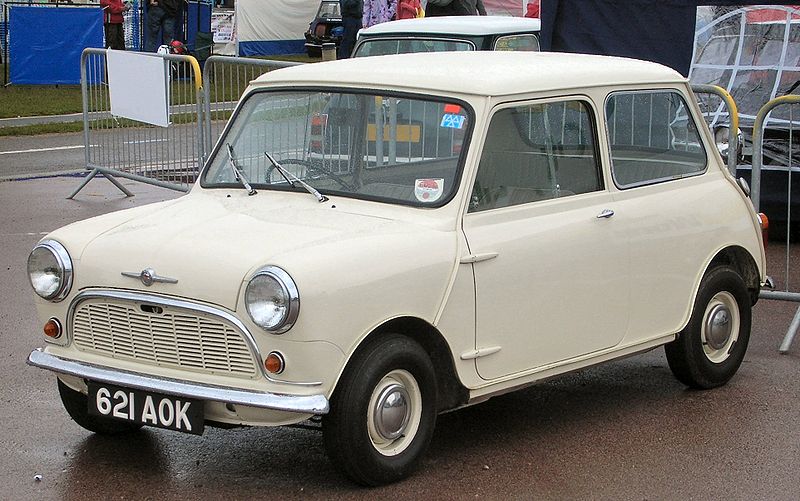
My Vauxhall Viva was a J-reg and I’m pretty sure it was a 1971 model. After the Mini it felt slow and very cumbersome, although if you really put your foot down there was a little band of torque in the middle of the rev range where you could almost feel acceleration. It wasn’t nearly so much fun to drive as the Mini.
It was four-speed and rear-wheel drive. Compared with modern cars and compared with the Mini, there was a massive amount of space under the bonnet. The engine, which was 1159cc, was really tall and thin and it sat longitudinally, with the crankshaft in line with the gearbox and drive-shaft. You could have got three engines side by side under the bonnet.
Our car was a two-door model and there was plenty of room inside, although not massively more than the Mini. It was dark blue and I bought it from a chap at work (a compositor at the Warrington Guardian). It had started life as a company car belonging to Les Senescall, chief sub at the newspaper.
Our time together didn’t get off to a great start: as soon as I bought it, I got landed with a massive (for the time) bill for work on the brakes and a few other jobs. I was working on the sports desk and I told the sports editor, who told the bloke who sold it to me and he gave me £100 back (I think his workmates shamed him into it). I’d paid about £600 for the car originally.
At the time, around 1977, the cars that dominated the UK market were the Ford Escort, Vauxhall Viva and the Austin/Morris 1100, which had just been replaced by the Austin Allegro. The Morris Marina would have appeared around this time too (but more of that later).
Ford and Vauxhall had traded blow for blow as they tried to be top seller and I’d always favoured a Vauxhall. The Viva HA was a lovely little car, although very boxy (three boxes in fact), but its replacement (the Viva HB) had gone all curvy and had the Coke-bottle design cues along its rear waistline (just like the Mk I Escort).
The second Escort had gone back to more angular lines, while the Viva HC had taken a more imaginative route. It seemed almost art deco in some of the design cues - strong bold lines, which looked almost as if they’d been sculpted. The front wings had a real edge to them and the bonnet, which had a bold ridge down the centre, was turned up at each side to mould with the wings. The grille had a strong centre feature which matched the ridge on the bonnet.
Other lines were smooth, with a prominent waistline and a rounded boot. I really liked the style of the car, although it always seemed to sit very high on its thin tyres so that, from the rear, it looked a bit out of proportion. The Viva models with bigger engines had fatter tyres and they looked really good; in fact, the later Magnum versions of the Viva were considered to be real muscle cars, a step above the old Viva GT or Escort GT.
Inside, the car was basic as all cars were. Instrumentation comprised a letterbox-style speedometer with a big red needle which wasn’t that easy to read, but then the speed camera was well over the horizon. Interior designers had a bit of a field day in the ’70s and ’80s when round dials were considered old-fashioned and form took a higher priority than function. There were other weird things like oval steering wheels (Austin Allegro), U-shaped handbrakes (Alfa Romeo), non-cancelling rocker switch for the flashing indicators rather than a stalk (Citroen) and a strange cow-horn-shaped indicator switch/stalk from SEAT.
The Viva didn’t have a radio and it didn’t have front head-rests (my two great ambitions for a car at the time. It did have windscreen washers, which had to be pumped by pushing a big black button under the dashboard, but that was about it. Wind your windows up and down and lock the doors and boor separately. There was no ABS, no servo and the brakes were drums all round.
It was a fairly reliable car, although I seem to remember always being worried that something would go wrong. Nothing did go wrong apart from it needing a new exhaust, but it was rusting away quite quickly. The driver’s seat also partially collapsed when part of the frame broke. I never did anything about that. The seats were quite wide and, although it lacked a bit of support on the right-hand side, it was still useable and made getting out of the car quite easy. you just opened the door, leaned a bit to the right and out you fell.
Rust was the great issue with all cars at this time. The Viva HC was quite solidly built with good thick steel, but it was prone to rust. Mine would have been about six years old when I got it and there was the tell-tale bubbling of paintwork along the top of the offside wing. Corrosion was eating through the untreated steel from the inside and no amount of polish would help with that.
Eventually, both wings had rust as well as bubbled paint and the two front inner mudguards rotted completely. I remember spending a couple of hours just pulling rusted metal from inside the front wing. It was quite worrying, but also quite addictive and pleasurable, feeling the metal just crumbling like a dry Weetabix. The car was on its way out and I sold it for about £200 before it became scrap value only.
We did one long journey in the car, driving from Warrington where we lived to Ipswich and back one day. I’d been unsettled at work and keen to progress, so I was looking for a new job. I went to interviews at Widnes (what a dump!) and Bolton, but pay for journalists was awful and I desperately wanted a company car. I’d seen a job as editor of Pig Farmer and thought that might be quite interesting. It also came with a much better salary and a company car - a Triumph Toledo no less.
Winston Churchill said that a cat looks down on you, a dog looks up to you but a pig is the only animal on earth who looks you in the eye as an equal. They were nice people and I was offered the job, but decided it was a cul-de-sac that I shouldn’t drive my career down and stayed put in Warrington for a bit longer. The journey to Ipswich in 1977 was much different to today. We took the M6 to junction 1 and got off at Lutterworth to Market Harborough, then it was A-roads to Kettering, Thrapston, Huntingdon, Cambridge, Bury St Edmunds and Ipswich. I was staggered how small Ipswich seemed compared to Warrington. The size of the Marks & Spencer store and Woolworths was always a good guide and those in Ipswich were tiny! It’s a bit bigger these days and the journey would be much easier - M6 and A14, motorway and dual carriageway all the way.
The Viva was also remarkable for the fact that Margaret took her first driving lessons in the car. She had some starter lessons from a lecherous driving instructor in Warrington and then I took her out. I was frightened to death, she wouldn’t be told anything (no surprise there!) and we ended up having a massive row and me driving back. I never gave her another lesson.
This is what Wikipedia has to say about the Viva HC:
The Viva HC (1970–1979) was mechanically the same as the HB but had more modern styling and greater interior space due to redesigned seating and positioning of bulkheads. It offered 2- and 4-door saloons and a fastback estate with the choice of either standard 1159 cc, 90 tuned 1159 cc or 1600 cc overhead cam power.
The American influence was still obvious on the design, with narrow horizontal rear lamp clusters, flat dashboard with a "letterbox" style speedometer, and a pronounced mid bonnet hump that was echoed in the front bumper.
The passing of the Viva marked a significant moment for Vauxhall, as it was the last car to be completely designed by the Luton-based company. All future Vauxhalls would be simply badge-engineered Opels, or in the case of the 2004 Vauxhall Monaro, a rebadged Holden.
The domestic market launch of the Viva HC coincided with one of the UK's periodic surges of debt-fuelled economic growth, and the latest Viva became Vauxhall's fastest-selling new model of all time, chalking up its first 100,000 units in under eight months months. Total HC sales ran to about 640,000 units, making combined Viva production top the 1.5 million mark. The millionth Viva, a gold HC, was driven off the production line amid much celebration on 20 July 1971. Although most Vivas were produced at Vauxhall's Ellesmere Port plant near Liverpool, the company's production lines were, by the standards of the time, flexible, and the millionth car was a product of the Luton factory. However, within seconds of the millionth Viva's completion at Luton, Ellesmere Port celebrated what was described - over-optimistically as matters turned out - as the first Viva of the second million.
The HC Viva has been less popular with classic car enthusiasts, as until recently 1970s cars weren't really sought after or considered true classics. This attitude is changing, with the best low-mileage examples of HC Vivas changing hands for a couple of thousand pounds on sites such as eBay.
I changed the Viva on a bit of a whim. I was driving past a used car showroom in Padgate and saw a Citroen GS on the forecourt. It was M-reg, they wanted just over £1,000 for it and it had front head restraints ...
Also see:
Ford Popular - click
Bedford HA Van - click
Morris Mini - click