Friday, 11 November 2011

Poppies for Remembrance Day


It was Remembrance Day today; two minutes silence to remember the dead starting at the 11th hour of the 11th day of the 11th month when the armistice was signed at the end of the First World War in 1918 (not 1911). Of course, it's now the dead of all wars that we remember, with a growing number from our ridiculous involvement in Afghanistan. 

When I was a boy, it was a huge thing. Many of those who fought in the First World War were still alive and the Second World War was still very fresh in the memory. The generation above me had lived through it.

There was a parade and ceremony at the war memorial in Works Lane and lots of men with lots of medals. One of the most prominent in the whole thing was Helen Woodward’s dad, nicknamed Smokey Woodward because he was a fireman at ICI. Ironically, he’d never been in the war due to his reserved occupation.

My dad never wore his medals and my mum (who was in the WRNS) had never claimed hers. Her brother Dick had done the same. He told me that he didn't want them - they were quite unconventional I guess. I still have dad's medals in the box in which they were posted to him. I'm not sure he's even looked at them more than once. Uncle Don said I should apply for a Palestine Medal as dad had served there after the war, but he’d never been bothered to and I didn’t really want to.

Mum and dad never went to the ceremony but would wear a poppy. In those days, Remembrance Day seemed more reflective, more sorrowful. Even as a child I felt the pain and the loss that my parents' and grandparents' generation were feeling.

A collection was made and it was for the British Legion, I don't remember calling it the Royal British Legion until I became a reporter and had to write about the organisation. Then they'd complain if we missed the 'Royal' out. The money helped wounded soldiers and their families, also war widows and children. And there were wounded soldiers about: old Homas who was a bit mental and had been since 1918, although I think that was partly due to drink, and Peter Roberts' grandad Joe Corker who fought in Mesopotamia, where it was so hot you couldn't hold your rifle unless it was wrapped in a rag and where an exploding shell had blinded him. I never saw him move out of his chair in their front room.

Nowadays, the horrors of the First World War have passed into popular legend. It's an icon for the horrors of war - the mud, the barbed wire, the trenches, the poison gas, men struggling through no-man's land easy targets for the German machine guns, poems by Owen and Sassoon. But was it so much more horrible than Coventry, Dresden, Belsen, Hiroshima?

It's become almost a cliché and Remembrance Day is now quite different in feeling to how it was. We report the sums raised as if it's the school fete, other service charities such as Help for Heroes muscle in on the available popular sympathy/donations. Few people wear poppies and often it's no longer the simple poppy that used to be paper, wax and wire, made by disabled soldiers. Now it's a plastic stem and pop-on stamen, possibly made in China like everything else. Even the simplicity of the poppy has gone. They all now have a little leaf (although I pull mine off - I'm a purist) and you can buy enamel lapel badges (I've seen a lot of those), poppy rings and large, lifelike oriental style poppies, which Davina at work was wearing today.

On TV, everyone has to have a poppy, but there's an unwelcome trend (in my opinion) for presenters and entertainers to wear glittery poppies and poppies sewn into dresses. What are they thinking about? A poppy is sad, a poignant symbol of lost lives, the flowers of a generation cut down, but frail and brave growing again among the mud on the battlefields, a sign of hope and regeneration.

Thursday, 10 November 2011

Woes of a commuter


Good heavens, what a day. I'm on the usual 6.10 out of King's Cross to Peterborough and it's been a miserable day transport-wise.

As I write this I'm jammed into a table seat near the window surrounded by three of the fattest blokes you've seen. The bloke opposite is a ginger with short hair and beard. He's wearing a T-shirt that says 'Natural Born Lover' but he clearly isn't. He's taken up the whole table with his laptop, iPhone and iPod (why would you need both) plus glasses case and I'm fighting a losing battle for my fair share of foot space. He's watching some kind if film and is firmly in his bubble.

Chap next to me has a belly busting of of his shirt, a beard and he's so fat he can't put his legs together. He's sitting with them splayed out and his belly is so big he doesn't know what to do with his arms. There's no room at his side and if he folds them they sit on the top of his distended gut like a hospital bed tray. He's also wheezing like an asthmatic, which is probably because he is.

Chap diagonally opposite is not in my space, but he is very big. Legs stretched out with a laptop on his lap!

I was hoping they would all get off at Hitchin but they're still on at St Neots!

God I need a couple of pints. Wish Max was home, so I could go to the pub.

Tubes have been dreadful today. Signal problems on the Victoria Line and something wrong with the Jubilee Line as well. My train this morning was a horror. Couldn't get on one - platform and train were too packed - and the one I managed to squeeze on was rammed. It took half an hour for a journey that normally takes 10 mins. At every station those stupid Victoria Line doors kept giving error messages (not shut properly) so the train can't pull away. Since the new trains were introduced it has been a nightmare. If someone brushes the door as it's closing, the train can't start and the doors have to be opened and closed again. The train was so packed this morning that we had to open and close about five times at Oxford Circus.


At Green Park, some chap pushed his way on at the last minute, pushed another chap to make room and he crashed into someone else, starting a grumpy argument about rudeness. The bloke who started it all took the "I'm just an honest bloke trying to get into work" moral high ground, but then kept stirring it all up by saying (about five times) that people with bad attitude just made it worse for everyone.


I thought it would be better coming home, but it was almost as bad. Platform was packed, train was packed and everyone was thoroughly grumpy.


Anderson Morgan who comes in from Greenford each day had had an argument with a bus driver who didn't pull into the bay, shut the doors in his face and then refused to open them even though he was banging on the door. Because the bus was stuck in traffic, he walked down to the next bus stop and got on there. He asked her (the driver) why she didn't let him on and she said she was on the road. Anderson said she was, but wasn't moving, hadn't moved and should have pulled into the bay. She said he should write and complain if he wasn't happy. Anderson took the "I'm just an honest bloke trying to get into work" moral high ground, then said she was stupid. Davina and I both thought he'd overstepped the mark. He was winning until that own goal.


Think I might walk tomorrow.

Wednesday, 9 November 2011

Family History - the medals


Had a real panic on Sunday. We had the house upside down trying to find Granddad Little's war medals. Turned out they were in a chest previously checked by Margaret, but ho-hum, just relieved to know where they were. The three medals awarded to my grandfather Richard Gibson Little are the 1914-15 Star; the British War Medal 1914-18 and the Allied Victory Medal.

I've included some information about the medals below.

The medals are all inscribed: 15891 Pte R G Little, York. & Lanc. R.

I presume the number is his service number and would suggest that the citation for the DCM (mentioned in the previous post) was a different R Little (different number and different regiment) - the York and Lancaster Regiment for my granddad as opposed to the West Riding Regiment.

The fact that he has the 1914-15 Star, as opposed to the 1914 Star would suggest that he wasn't involved in the very earliest battles of the war, in particular the First Battle of Mons. I think that bit of misinformation came from Uncle Don who was a career soldier. I showed him the medals to see if he knew which ribbon went with which medal. He didn’t, but he told me that it was a Mons Star which meant he’d fought in the first Battle of Mons. In fact, there’s a very slight difference in the 1914 Star and the 1914-15 Star (which is explained below). It’s useful to have the internet to find out information like that. I was able to see which ribbon went with which in a flash.

I was also able to find out some information on the York and Lancaster regiment. The restricted recruiting area for the regiment (described below) suggests that Richard was in South Yorkshire when he joined up. We were always led to believe that he was in the army when the First World War was declared, so he must have moved across from Penrith (not that far really) before the war and been working in South Yorkshire.

I’ll have to look into his war record, but he could well have been in the Second Battalion, which was in Ireland when war was declared and shipped over to France in September 1914. It arrived in time to help stem the German breakthrough and stabilise the line of trenches which became the Western Front. It wasn’t a great regiment to join with almost 9,000 killed from 57,000 men. That’s a 16 per cent chance of being killed. The actual rate of attrition for those in France would have been much higher because half the regiment was serving in other, less dangerous theatres. I've attached a small note (below) from Wikipedia on the York and Lancaster Regiment and also some notes on the medals.

There is still a mystery over the ‘Gibson’. At some stage Richard Little became Richard Gibson Little. He’s described as R G Little on his war medals. The story was that he was married before his marriage to Nelly (my grandmother), but the family didn’t approve, his wife died and, heartbroken, he adopted her name and joined the army.

He was married before, but to Annie Braithwaite and in 1917, when he’d already been in the army for at least three years. She died in 1919. Perhaps the Gibson story has some truth in it, but perhaps there was no marriage, just a love affair. Richard clearly wasn’t rich or skilled (and was also possibly illegitimate), so he might not have been a great catch from a father's point of view. Richard was born in 1888 and so would have been 24 when war broke out – plenty old enough to have had a 'past'.

I guess we’ll never know the truth, but I think there’s some root for the stories there.

History of the York and Lancaster Regiment
It was formed in 1881 through the amalgamation of two other regiments:
                84th (York and Lancaster) Regiment
The title of the regiment was derived not from the cities of York and Lancaster, or from the counties. Instead, the name came from the fact that it recruited from, amongst other places, landed properties owned by the Duchy of York and the Duchy of Lancaster. The regiment's recruiting area was in fact wholly within South Yorkshire (an area known as Hallamshire). Indeed, the regiment's Territorial Army battalion dropped its number and was known simply as The Hallamshire Battalion from 1924.
The new regiment saw service in both Egypt and Sudan immediately after its formation, and also during the Second Boer War, when it took part in the Relief of Ladysmith.

First World War
The regiment raised 22 battalions for service in the First World War, of which eight saw action on the first day of the Battle of the Somme. During the war it suffered 48,650 casualties out of 57,000 men serving, with 8,814 killed or died of wounds (72 out of every 100 men being either wounded or killed). The regiment won four Victoria Crosses and 59 battle honours, the largest number for any English regiment during the war.

The 22 battalions consisted of the two regular battalions, the depot battalion, six Territorial Army battalions, nine Service, two Reserve, one Transport and one Labour battalion. 17 of the 22 battalions saw service overseas.

During the Battle of the Somme the Yorks and Lancs' eight battalions that went over the top on the first day suffered huge casualties, the three Pals battalions; 12th (Sheffield City), 13th and 14th Barnsley Pals Battalions, in particular suffering heavily. Eleven battalions of the regiment fought during the Somme campaign.
The regular 1st Battalion returned from service in India to be formed up as part of the 28th Division. The 28th Division consisted of regular battalions returning from overseas service and was shipped to France in January 1915. The 1st Battalion saw action in the Second Battle of Ypres and the Battle of Loos. The battalion was then shipped to the Balkans as part of the British Salonika Army where it would remain until the end of the war.[2] While the battalion was still in France Private Samuel Harvey won the York and Lancs' first Victoria Cross since the regiment's creation in 1881.

The 2nd Battalion was stationed in Ireland with the 16th Brigade when war broke out. The battalion arrived on the Western Front in September 1914 with the 6th Division as part of the original British Expeditionary Force. The 2nd Battalion fought its first battle at Armentières during the Race to the Sea. The 2nd Battalion fought in most of the major battles of the war including the Battle of the Somme and spent the entire war serving in France and Flanders. Private John Caffrey, 2nd battalion, won the Victoria Cross in 1915.

These are the three medals awarded to Richard Little:
Pip, Squeak and Wilfred


Pip, Squeak and Wilfred are the affectionate names given to the three WW1 campaign medals — The 1914 Star or 1914-15 Star, British War Medal and Victory Medal respectively. These medals were primarily awarded to the Old Contemptibles ( B.E.F. ). and by convention all three medals are worn together and in the same order from left to right when viewed from the front. The set of three medals or at least the British War Medal and the Victory Medal are the most likely medals to be found among family heirlooms.

When the WW1 medals were issued in the 1920's it coincided with a popular comic strip published by the Daily Mirror newspaper. It was written by Bertram J. Lamb (Uncle Dick), and drawn by the cartoonist Austin Bowen Payne (A.B. Payne). Pip was the dog, Squeak the penguin and Wilfred the young rabbit. It is believed that A. B. Payne's batman during the war had been nicknamed “Pip-squeak” and this is where the idea for the names of the dog and penguin came from. For some reason the three names of the characters became associated with the three campaign medals being issued at that time to many thousands of returning servicemen, and they stuck.

Mutt and Jeff”

The two British campaign medals commonly found as family heirlooms nicknamed Mutt and Jeff: the British War Medal and the Victory Medal.
In a similar vein when only the British War Medal and Victory Medal are on display together they are sometimes known as “Mutt and Jeff”.


The 1914 Star

Established in April 1917.
Also known as 'Pip' or the 'Mons Star'.
This bronze medal award was authorized by King George V in April 1917 for those who had served in France or Belgium between 5th August 1914 to midnight on 22nd November 1914 inclusive. The award was open to officers and men of the British and Indian Expeditionary Forces, doctors and nurses as well as Royal Navy, Royal Marines, Royal Navy Reserve and Royal Naval Volunteer Reserve who served ashore with the Royal Naval Division in France or Belgium.
A narrow horizontal bronze clasp sewn onto the ribbon, bearing the dates '5th AUG. - 22nd NOV. 1914' shows that the recipient had actually served under fire of the enemy during that period. For every seven medals issued without a clasp there were approximately five issued with the clasp.


Recipients who received the medal with the clasp were also entitled to attach a small silver heraldic rose to the ribbon when just the ribbon was being worn.
The reverse is plain with the recipient's service number, rank, name and unit impressed on it.
It should be remembered that recipients of this medal were responsible for assisting the French to hold back the German army while new recruits could be trained and equipped. Collectively, they fully deserve a great deal of honour for their part in the first sixteen weeks of the Great War. This included the battle of Mons, the retreat to the Seine, the battles of Le Cateau, the Marne, the Aisne and the first battle of Ypres. There were approximately 378,000 1914 Stars issued.
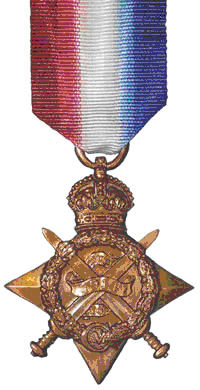
The 1914-15 Star (this is what my granddad has)


Established in December 1918.
Also known as 'Pip'.
This bronze medal was authorized in 1918. It is very similar to the 1914 Star but it was issued to a much wider range of recipients. Broadly speaking it was awarded to all who served in any theatre of war against Germany between 5th August 1914 and 31st December 1915, except those eligible for the 1914 Star. Similarly, those who received the Africa General Service Medal or the Sudan 1910 Medal were not eligible for the award.
Like the 1914 Star, the 1914-15 Star was not awarded alone. The recipient had to have received the British War Medal and the Victory Medal. The reverse is plain with the recipient's service number, rank, name and unit impressed on it.
An estimated 2.4 million of these medals were issued.
The British War Medal, 1914-18 (also this)
Established on 26th July 1919.
Also known as 'Squeak'.

The silver or bronze medal was awarded to officers and men of the British and Imperial Forces who either entered a theatre of war or entered service overseas between 5th August 1914 and 11thNovember 1918 inclusive. This was later extended to services in Russia, Siberia and some other areas in 1919 and 1920.

Approximately 6.5 million British War Medals were issued. Approximately 6.4 million of these were the silver versions of this medal. Around 110,000 of a bronze version were issued mainly to Chinese, Maltese and Indian Labour Corps. The front of the medal depicts the head of George V.

The recipient's service number, rank, name and unit was impressed on the rim.
The Allied Victory Medal (and this)
Also known as 'Wilfred'
It was decided that each of the allies should each issue their own bronze victory medal with a similar design, similar equivalent wording and identical ribbon.
The British medal was designed by W. McMillan. The front depicts a winged classical figure representing victory.
Approximately 5.7 million victory medals were issued. Interestingly, eligibility for this medal was more restrictive and not everyone who received the British War Medal ('Squeak') also received the Victory Medal ('Wilfred'). However, in general, all recipients of 'Wilfred' also received 'Squeak' and all recipients of 'Pip' also received both 'Squeak' and 'Wilfred'.

Friday, 4 November 2011

Family history mysteries


Mike Towers, husband of my cousin Jennifer (she’s the daughter of my mum’s younger brother Dick), has been doing some family history research. He mailed me some time back to say that he’s been looking into my grandfather (mum’s dad) Richard Gibson Little.

The story was always that he had been born in Cumberland (now Cumbria) and had ginger hair (which was where my and my sister’s hair colour had come from). I was told he was born Richard Little, but had married first, above his status, and his wife’s family (wealthy shop-owners in Carlisle) had disowned her. She had died and Richard, presumably heartbroken, had taken her maiden name (Gibson) as his middle name and had joined the army.

I know that he had fought in the First World War and was in the army when the war broke out. He was therefore an Old Contemptible and had also fought in the first battle of Mons, when the German army invaded Belgium and tried to break through to Paris. They were stopped at the Mons canal by British riflemen, who had kept up such a fierce rate of fire that the Germans thought they were facing machine guns. But the British were outflanked (when those dodgy Frenchies gave way) and the army faced a difficult retreat into France and the Western Front was formed.

I have three medals from the war, including a Mons Star, awarded to those who fought in the first battle of Mons, so that much is probably true; also a fearsome bayonet from later in the war.

After the war, Richard Little settled in Yorkshire and married (secondly) to my grandmother Nelly and had six children – Jack, Nellie (my mother), Dick, Joyce, Jessie and Margaret. He worked as a cowman in Adwick-le-Street, just off the A1 north of Doncaster. His wasn’t a charmed life; his wife had suffered a stroke and was partly paralysed and I think she had a second, fatal stroke soon after the birth of Margaret. Jack was adopted by family, but the rest of the family, including the baby, were put into an orphanage in Doncaster, called Stanley House. My grandfather lived alone in a tied cottage in Adwick and probably didn’t look after himself too well. He died from pneumonia just before my mother’s 14th birthday.

Now Mike has been doing some proper research, which, of course, has debunked some of the family myths. Richard was born in Cumberland, possibly illegitimate and was not brought up by his birth parents. He did have a marriage before marrying my grandmother, but the Gibson link and the disowned daughter don’t tally. Mike reached something of a block and could find out nothing more. It is possible Richard Little has a relationship before his first marriage.

He has now contacted me to ask about the medals and I’ve said I will photograph them carefully to see if I can capture all the detail. Mike has also found a record from the West Riding Regiment for an R Little, who was awarded the Distinguished Conduct Medal at Ypres. That may, or may not, be my grandfather; there certainly isn’t a DCM among the three medals I have.

I hope to get stuck into family history proper when I retire, but Mike’s work is shedding some light on the past. I’ve included his findings and the words of the DCM citation below.

Interesting the comment about Gibson and shops (grocers have cropped up before) but Jacqueline says the Uncle Jack always talked about the Gibson’s being cobblers and a low grade family with whom the Little’s had no truck! 

Still don't know were the Gibson name came from and, having just had a look back at our emails since we started this family tree lark, I couldn’t believe that the first one was 29 Dec 2001. Don’t know how much farther you have got with your tree and I think that your recollections of your Granddad Little are probably based on a family myth about the Gibson's which I have to change as I can trace no connection with a Gibson family. 

That said, I am still struggling to clarify his birth and parent details but this is what I have got at present.

Richard Gibson Little
Born 9 April 1888 – only registered birth is as Richard Little in Penrith and not Richard Gibson Little. Birth certificate shows mother as Margaret Little nee Lowis, Charwoman of Ainstable, Penrith.  No father’s details appear on the certificate and father thought to be a Joseph but cannot trace a marriage to Joseph (see below).   There are a number of Margaret Lowis that I’m trying to pin down.

His mother is said to have died when Richard was 4/5 years old i.e. 1892/3 and then fostered by a maiden aunt but census return of 1891 suggest different as already being fostered at age 3.

First Marriage - shown as Richard Gibson Little
This was to an Annie Elizabeth Braithwaite born Q1/1894 Penrith who was confirmed 12 May 1910 at C of E Ousby, Penrith – Aunt Margaret has her confirmation book endorsed by the vicar.

Married 20 Sep 1917 – Ousby, Penrith. Died 19 Nov 1919 in or from child birth or "Parturition, Post Partum haemorrhage and Exhaustion from Septicaemia"

At marriage no father’s name shown for Richard on certificate. Annie came from a family of farmers, John Cheesborough Braithwaite of Ousby, Penrith with 30 acres. This is confirmed to me by other Genes Reunited members and census records.

Second Marriage shown as Richard Gibson Little
To Nelly Beatrice Burrows – birth and death records show Nelly but marriage cert. as Nellie
Born 6 April 1894 – Warter, Pocklington
Married 20 Jun 1920 – Adwick-le-Street, Doncaster

Died 23 May 1933 – Doncaster
His Death – 15 Dec 1937 – Doncaster
At marriage a father is shown as Joseph Little, a miller – see below re Barnes
Census Records show him as Richard G Little
1891c - Nurse Child age 2; living with Anthony Sander and family at Cross House, Becks, Ainstable, Armathwaite, Penrith

1901c - living as son age 12 with Joseph Barnes at Ruckcroft, Ainstable, Penrith

1911c - cannot pin him down – there is an entry for a Richard Little in the army but not conclusively him.

Currently I’m working on the maiden aunt fostering him theory as, in 1901, Joseph Barnes was married to a Margaret nee Little who may have been Richard’s sister. The problem is matching this Margaret with a parentage. I have found a family of Little’s with children of Margaret and a Joseph who was much older and who married a different women.  If this is the correct family it may support illegitimacy.

I’m beginning to think that Joseph Barnes, who was a miller, was misquoted as the father on ‘respectability’ grounds on Richard’s marriage to Nellie. I have come across this before in my mother’s tree where children were illegitimate. So is Richard illegitimate and did Margaret Lowis also use Little for respectability – its frustrating to say the least.

The next problem is that if Richard’s father was a Joseph Little then there are dozens in Cumbria and I need to address this as a separate research line but I do not hold out any hope.

Presently, I’m speaking with Doncaster Council to see if they have any archived records for Stanley House Children's home.


Thursday, 3 November 2011

A day off and our anniversary


I’m writing this entry on my morning commute. It’s a regular day – up at 5am, let the dogs out (Holly is always jumping around the kitchen with glee, Gravel looks up sleepily from his basket but generally has a trot outside if it’s not raining); then make a cup of tea (fill the kettle through the spout because taking the lid off makes Holly bark loudly); take the tea and dogs upstairs to wake Margaret, Margaret yells at Holly (dirty paws, jumping on her face, licking her face, or all three), then I sit in bed and drink my tea, shower, get dressed and leave at 6.20 or 6.25am to catch the 6.53 train which gets me into King’s Cross at 8am. From there, it’s generally Victoria line to Victoria and into work for 8.20am, but sometimes I’ll walk (which takes an hour) and sometimes I get off at Green Park and walk through the park past Buckingham Palace. This morning it will be straight on the tube, we’re so busy at work that I can’t afford any wasted time and I don’t like to stay later than 5.30pm. Coming home, I leave at 5.30pm, walk to Pimlico or Victoria (depending on whether I’m out at 5.30 or 5.40) and tube to King’s Cross for the 6.10 First Capital Connect to Peterborough, which arrives at 7.20pm. Margaret picks me up and, with luck; I’m home at 7.45pm.

So I leave the house at 6.20am and get back at 7.45pm, bed at 9pm otherwise it’s just too hard to get up in the morning.

Well, it was our 37th wedding anniversary yesterday and I had the day off so my daily commuter grind was happily absent.

It has been a remarkably mild autumn, one of the warmest Octobers on record and very dry in the east, as it has been all year. In April, no rain at all fell in Cambridgeshire and we had quite a dry summer, although temperatures were not particularly high. In October, I think we had one day’s rain all month. It’s been a real east/west split, there have been floods in the west and it has been a wet summer. Good to live in the east, although they are talking of water restrictions if we don’t get a wet winter to replenish aquifers.

It was mild and sunny 37 years ago on our wedding day and for the following week when we were on honeymoon in London (at the Henry VIII hotel near Lancaster Gate). We didn’t have lots of money, so spent quite a lot of time walking in the parks, which were carpeted with crunchy leaves from the London Planes and still had lots of autumn colour.

Yesterday morning, it was warm enough to have breakfast on the decking in front of the summerhouse, although you have to be careful that a falling leaf doesn’t land in your porridge! Of course, I didn’t get up at 5am and had the luxury of a 6.15 lie-in and a cup of tea from Margaret.

After breakfast, we’d planned a shopping trip to get some ingredients for our evening meal (pasta) and to buy Margaret some walking shoes, as she’s been having trouble with a sore heel and Achilles tendon. We thought some shoes with decent cushioning and foot support would help her recovery. However, I had lost the recipe I had photocopied from a newspaper, so we decided on fish and chips from Crowland.

We went to Peterborough Garden Park and managed to get a pair of shoes from Cotswold, the walking shop, for £65. Margaret seemed to think they would help, but said later that her feet were killing her, although she’d then walked for quite a long way. We were going to have a coffee in Van Hage, the garden centre (which sells all kinds of things as well as plants) and I had a good nosey round for the first time (Margaret goes quite often). We bought some fat balls for the birds and a candle, but I couldn’t face the coffee shop – it was full (as was the whole garden centre) with old people. Barbara, our neighbour who is around 70, had been to Southwold for the weekend and had told Margaret that it was nice but there were a lot of old people there. She hadn’t seen the irony. Well Van Hage is like Southwold. Old people are all very well (I’m almost old myself) but when they get into a coffee shop or café, it brings out the worst in them. They fuss about getting a table, they moan about how dear things are and they stand at the coffee counter getting all confused – what’s a mocha again? They all look very anxious and don’t seem to relax and enjoy the experience, but they can’t wait to come back for another treat at Van Hage. I think the place is a magnet for all the old people in Peterborough who can still drive and face the terrors of the ring road.

Anyway, I couldn’t face queuing and eating with that lot, so we headed home with our candle and fat balls and I had a cup of tea and slice of Bara Brith on the decking. It was now genuinely warm.

I took the dogs for a walk around Toneham and had gone up the avenue and along the top to the farm when Gravel emerged from the ditch particularly filthy. Rather than have to bath him at home, I turned back so he could have a swim in the Thorney River and clean up a bit. Holly, who is normally brilliant off the lead, then picked up the scent of a pheasant and put one up in the upper field, which is planted with oilseed rape. No sooner had she started chasing that, than another was put up and a new chase started. She’d put three up when I lost sight of her over the brow. It’s the first time I’ve seen her get Springer syndrome (where the nose takes over from all other senses, particularly hearing) and when she did emerge back into sight, she was at the wrong end of the field, could see me and set off to got through the farm (the way we’d been going). Some frantic shouting and waving got her attention and she caught up with me halfway along the path, panting like a steam train. I made sure they had a good swim and when I got home, Margaret had bought a paper, so it was back to the summerhouse for a read. The wind had picked up and it was a bit blowy on the decking. We had planned to have a gin martini outside, but a good glug of strong martini is not recommended before a drive to Crowland (or anywhere else for that matter) so another cup of tea was all I had.

Margaret had bought us some gin as a joint anniversary present – she said it was the recurring theme of our summer (gin and tonic on the patio/decking/summerhouse). It was called London Gin and was 46%. There are lots of so-called artisan distilleries springing up and I though this was another she’d found. Earlier in the week, Tom had been talking about seeing some gin made in Highgate, so I had a look at the label on this to see if it was, by slim chance, Highgate gin. It was actually made in Holland, a country with a fine reputation for gin, but not where you’d expect a bottle labelled London Gin to come from.

Anyway, our day tailed off into fish and chips (far too big a portion) and instead of leaving some, I ate it all and felt so full I couldn’t move for an hour. I did manage to get up to make us a G&T (not a martini) and the gin was very good, but I was nodding off in the middle of a very good documentary by Frank Skinner on George Formby Jnr. Bed at 9pm and asleep at 9.30 after checking e-mails on my Blackberry. Another few items to add to my list the next day.

Tuesday, 1 November 2011

Poker playing witches

Interesting night last night. I met Sam and Tom in the World's End on Stroud Green Road. Got there at 6.10pm to find Tom sitting on his motorcycle outside. He was worried about getting a ticket because free parking didn't start until 6.30pm, but when I arrived we went into the pub and found a seat where Tom could keep an eye on his bike (he's very worried about it being stolen because he doesn't have theft insurance).


We'd been in the pub for literally a couple of minutes when some people said there was a traffic warden putting a ticket on his bike. Tom bombed out of the pub and just managed to get his helmet on and ride away before the warden could strike. It was literally 10 minutes before the parking restrictions ended; they must have either been watching Tom or have a policy of doing a last, late sweep to get anyone who thinks "it's nearly time, no-one will do me now."


It was poker night and Hallowe'en fancy dress night. Bit bizarre with all the tables set out with chips and poker sets, then all these people in witches costumes, torn shorts, fake blood and other get-ups started arriving. There was someone dressed as a cat and someone who I thought was wearing a dog suit, but it turned out to be Danger Mouse. I guess it helps your poker face if you have a Danger Mouse mask on.


Sam arrived and wasn't drinking because he's on anti-biotics and he was worried about his liver. Tom couldn't have any more because he was on his motorcycle and hadn't eaten anything since breakfast. So it was lime and lemonade for Sam, Tom had nothing and I had another pint of Doombar. Tom had got Lucy a bottle of Japanese wine for her birthday. Lucy wasn't very well, she had a stomach upset (either a virus or something to do with the mussels, oysters of sausage-stuffed mackerel that Sam had made for them at the weekend). Just the thought of sausage-stuffed mackerel makes me feel ill, but I've never tried it, so can't say for sure.


Lucy's dad was at their flat bringing Lucy a present round. She hasn't seen him since last Christmas, so Sam and I hung around a bit to give them time.


Lucy didn't look too well, she was very hot (definitely a virus, says Sam) and we were not very considerate by getting our dinner out. I'd bought some cheese. Ripon Cheese in Pimlico has a deal almost every day where you can get four cheeses for £7.50, so I've taken to getting a tray when I go to Tom or Sam's. It's great value - there's a Swiss cheese called Panoramo (which is hard and has a herb-crusted skin), a French goat log called Buche Blanche, a soft Brie (Irish in this case) and a wedge of St Agur. I'd also got a French stick and taken some Bara Brith which I'd made at the weekend.


Watched a bit of TV - University Challenge and then a Ricky Gervais comedy called An Idiot Abroad. Sam said he didn't think I'd get it and I don't think I did. I don't think Ricky Gervais is a very nice man. I was always uncomfortable watching The Office and there were moments in Extras where I felt he was venturing into territory he shouldn't. They were funny, but sometimes uncomfortable. An Idiot Abroad seems just uncomfortable.